
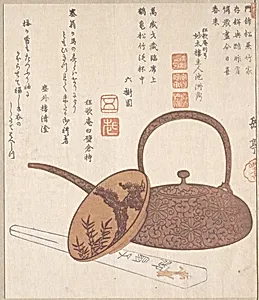
Wine Pot, Wine Cup and Folded Fan
19th century
Medium
Part of an album of woodblock prints (surimono); ink and color on paper
Dimensions
7 11/16 x 6 9/16 in. (19.5 x 16.7 cm)
Classification
Prints
Culture & Period
Japan · Edo period (1615–1868)
Department
Asian Art
Museum
Metropolitan Museum of Art, New York, NY
Credit
H. O. Havemeyer Collection, Bequest of Mrs. H. O. Havemeyer, 1929
Accession Number
JP2262
Rights
Public Domain
Tags
Art Historical Context
Nestled within an exquisite album of woodblock prints *Wine Pot, Wine Cup and Folded* by Yashima Gakutei captures the refined elegance of 19th Japan during the Edo period (1615–1868). This surimono—a luxurious, privately commissioned print often produced for poetic gatherings or New Year's celebrations—showcases everyday objects arranged with poetic simplicity: a sake pot, cup, and delicately folded fan. Gakutei, a master of ukiyo-e tradition, infuses the scene with quiet sophistication, evoking the era's appreciation for subtle beauty amid urban prosperity. Crafted in ink and color on paper, the print measures a intimate 7 11/16 x 6 9/16 inches, perfect for personal albums. Surimono like this one stand out for their technical brilliance, featuring crisp lines, vibrant hues, and sometimes subtle embossing or mica for a tactile glow—though here the focus is on harmonious composition. Unlike mass-produced ukiyo-e, these were elite commissions, blending art with literature, often framing kyōka poems (humorous waka variants). From the H. O. Havemeyer Collection at The Metropolitan Museum of Art, this piece highlights Japan's cultural reverence for the ephemeral pleasures of sake and fans, symbols of leisure and artistry. A charming window into Edo Japan's refined tastes!
About the Artist
Yashima Gakutei · 1786–1868
Yashima Gakutei (c. 1786–1868), born in Osaka as the illegitimate son of a Tokugawa shogunate samurai named Hirata, adopted the name from his mother's subsequent marriage into the Yashima clan. Little is documented about his early years beyond these familial ties, but he pursued artistic training under the esteemed ukiyo-e masters Totoya Hokkei and Katsushika Hokusai, absorbing their precision in ...