
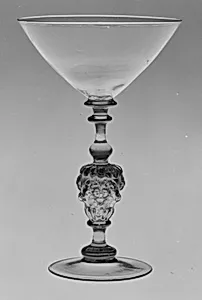
Wineglass
Unknown Artist
16th century
Medium
Colorless (strongly greenish gray) nonlead glass. Blown, mold blown.
Dimensions
H. 18.5 cm
Classification
Glass
Culture
Façon de Venise, northern European
Department
Robert Lehman Collection
Museum
Metropolitan Museum of Art, New York, NY
Credit
Robert Lehman Collection, 1975
Accession Number
1975.1.1158
Rights
Public Domain
Art Historical Context
This elegant 16th-century wine, standing at 18.5 cm tall, exemplifies the refined artistry of Façon de Venise glass—a northern European style inspired by the luxurious techniques of Renaissance Venice. Crafted from colorless (yet subtly greenish-gray) nonlead glass using blown and mold-blown methods, it showcases the era's innovative glassblowing prowess. The mold-blowing technique allowed artisans to create precise patterns and shapes, mimicking the intricate, thin-walled vessels prized in Venice, while the soda-lime glass composition reflects the materials available beyond Italy's Murano workshops. Produced amid Europe's growing fascination with Venetian glass—whose secrets were fiercely guarded—Façon de Venise pieces like this one proliferated in the Netherlands and Germany. Venice's 15th-century bans on exporting artisans spurred these imitations, democratizing opulent tableware for the elite. The greenish tint, from iron impurities in the silica, adds a distinctive patina, evoking the smoky allure of historic banquets. Housed in the Metropolitan Museum of Art's Robert Lehman Collection since 1975, this anonymous masterpiece highlights glass as both functional art and cultural status symbol, bridging trade, craft, and connoisseurship in the 16th century.