
Winter
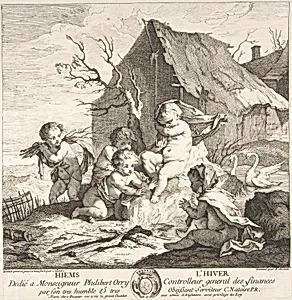
Medium
Etching with engraving
Dimensions
sheet: 10 3/16 x 9 13/16 in. (25.8 x 25 cm)
Classification
Prints
Department
Drawings and Prints
Museum
Metropolitan Museum of Art, New York, NY
Credit
Harris Brisbane Dick Fund, 1953
Accession Number
53.600.2455
Rights
Public Domain
Tags
Art Historical Context
Charles Joseph Natoire (1700–1777), a leading French Rococo artist, captured the playful essence of winter in this enchanting etching with engraving. Known for his elegant, whimsical style influenced by the ornate curves and lighthearted themes of the Rococo movement Natoire often depicted lively scenes blending mythology, nature, and daily life. This print, from the Metropolitan Museum of Art's Drawings and Prints department, a cozy yet frosty moment through tags like children, swans, fire, and—likely portraying young figures gathered around a hearth amid a snowy landscape, with graceful swans adding a touch of poetic elegance. The medium of etching combined with engraving allowed Natoire to achieve intricate details and tonal depth: etching for fluid lines and soft shading, engraving for precise highlights. Prints like this were vital in 18th-century Europe, making high art accessible beyond oil paintings and fostering the spread of Rococo's decorative charm. Acquired through the Harris Brisbane Dick Fund in 1953, it exemplifies the Met's commitment to preserving such reproductive techniques that democratized beauty. Measuring 10 3/16 x 9 13/16 inches, *Winter* invites visitors to savor its delicate contrasts—warm fire against icy chill—reminding us of Rococo's delight in sensory joys amid seasonal change. A gem for print enthusiasts!
About the Artist
Charles Joseph Natoire · 1700–1777
**Charles-Joseph Natoire** (3 March 1700 – 23 August 1777) was a leading French painter of the Rococo period, celebrated for his elegant mythological and historical scenes. Born in Nîmes to sculptor Florent Natoire, he received his initial training in drawing from his father before moving to Paris in 1717. There he studied first under Louis Galloche at the Académie royale de peinture et de sculptu...