
Winter, from The Seasons
1700/20
Medium
Wool and silk, slit and double interlocking tapestry weave
Dimensions
540.1 × 384.9 cm (212 5/8 × 151 1/2 in.)
Classification
weaving - tapestry
Department
Textiles
Museum
Art Institute of Chicago
Accession Number
80479
Rights
Public Domain
About this artwork
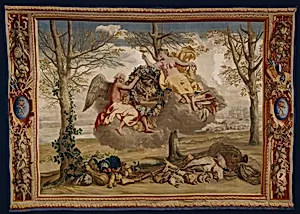
Winter presents Saturn (the god of agriculture and time) and Juventas (the cupbearer to the gods on Mount Olympus) on a large cloud. The musical instruments and the mask at Juventas’s feet allude to ballet performances and masked balls—the favored pastimes of the French court—while Saturn holds a floral wreath that features a ballet scene. In the foreground, a variety of winter vegetables are visible, along with a cage, nets, a gun, and game of various kinds: the results of a successful hunt. Th...
Art Historical Context
Behold *Winter, from The Seasons*, a monumental tapestry designed by Charles Le Brun, the preeminent French artist of Louis XIV's court. Created between 1700 and 1720, this work captures the allegorical chill of winter through Le Brun's grand Baroque style, characterized by dramatic compositions and classical grandeur. As director of the royal Gobelins manufactory Le Brun pioneered tapestry series like *The Seasons* to adorn Versailles and noble palaces, blending mythology, nature, and seasonal metaphors to celebrate the Sun King's eternal reign. Woven in luxurious wool and silk using slit and double interlocking techniques, the tapestry achieves remarkable detail and durability. Slit weave allows sharp color transitions for intricate patterns, while double interlocking ensures strength across its vast 5.4 x 3.8 meter scale—perfect for insulating opulent interiors. These methods, perfected at Gobelins, elevated tapestries from mere wall hangings to high art, rivaling paintings in narrative power. Today, at the Art Institute of Chicago, *Winter* evokes 18th-century Europe's love for sumptuous textiles as symbols of wealth and culture. Imagine it warming a grand hall, whispering tales of fleeting seasons amid eternal splendor.
About the Artist
Charles Le Brun · 1619–1690
Charles Le Brun (1619–1690) was the most powerful artistic figure in seventeenth-century France, serving as the virtual dictator of official taste during the reign of Louis XIV and shaping the visual identity of the French Baroque in ways that resonated for generations. Born in Paris, he trained under the painter Simon Vouet before traveling to Rome in 1642, where he studied the works of Nicolas P...