
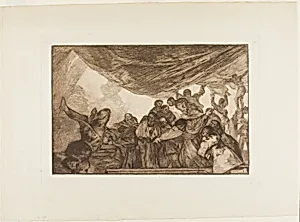
Without commending himself either to God or the devil, plate 15 from Los Proverbios
Medium
Etching, burnished aquatint and lavis printed in sepia ink on ivory wove paper
Dimensions
Image: 21.1 × 31 cm (8 5/16 × 12 1/4 in.); Plate: 24.6 × 35.5 cm (9 11/16 × 14 in.); Sheet: 35 × 48.7 cm (13 13/16 × 19 3/16 in.)
Classification
etching
Department
Prints and Drawings
Museum
Art Institute of Chicago
Accession Number
44882
Rights
Public Domain
Art Historical Context
**Without Commending Himself Either to God or the Devil**, plate 15 from Francisco Goya's *Los Proverbios* (1815–24), captures the Spanish master's haunting vision of human ambiguity. Created during Goya's later years amid Spain's turbulent post-Napoleonic era, this etching reflects his shift toward darker, more introspective themes after personal hardships like deafness and political upheaval. Part of an enigmatic series of 22 prints—published posthumously in 1864—*Los Proverbios* (also called *Los Disparates*) uses proverbs to satirize folly, superstition, and societal ills, with this plate evoking a figure caught in moral neutrality, neither seeking divine nor infernal favor. Goya's virtuoso technique shines here: etching for precise lines, burnished aquatint for subtle tonal gradations, and lavis for soft, painterly washes, all printed in warm sepia ink on ivory wove paper (image: 21.1 × 31 cm). These innovative methods, honed from his earlier *Los Caprichos*, create dreamlike shadows and textures that amplify psychological tension, bridging Romanticism and modernism. Housed in the Art Institute of Chicago's Prints and Drawings department, this work exemplifies Goya's enduring legacy as a critic of human nature, inviting visitors to ponder the proverb's wry wisdom in an age of uncertainty.
About the Artist
Francisco José de Goya y Lucientes · 1746–1828
Francisco José de Goya y Lucientes was born on March 30, 1746, in the small Aragonese village of Fuendetodos, Spain, to José Benito de Goya, a master gilder, and Gracia de Lucientes. The fourth of six children in a modest lower-middle-class family, Goya received a basic education before beginning his artistic training at age 14 under the local painter José Luzán y Martínez in Zaragoza, where he sp...