
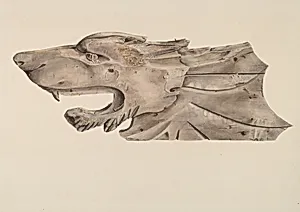
Wolf's Head
c. 1939
Medium
watercolor and graphite on paperboard
Dimensions
overall: 31.4 x 44.2 cm (12 3/8 x 17 3/8 in.) Original IAD Object: 8" high; 18 1/2" long
Classification
Index of American Design
Department
CG-W
Museum
National Gallery of Art, Washington, D.C.
Credit
Index of American Design
Accession Number
1943.8.17093
Rights
Public Domain
Art Historical Context
**Wolf's Head**, a captivating watercolor and graphite rendering by artist Harry King, dates to around 1939 and measures 31.4 x 44.2 cm. This work faithfully captures a folk art object—a striking wolf's head originally 8 inches high and 18½ inches long—likely a carved wooden artifact evoking early American craftsmanship, such as a trade sign, nautical figurehead or decorative carving. King's meticulous technique blends the fluidity of watercolor for rich textures and tones with the precision of graphite for fine details, bringing the snarling visage to life on paperboard. Created as part of the Index of American Design (IAD), a New Deal-era Federal Art Project (1935–1942), this piece exemplifies a national effort to document and celebrate everyday American folk art amid the Great Depression. Sponsored by the Works Progress Administration, the IAD employed artists like King to produce over 15,000 detailed plates preserving regional crafts at risk of loss. Housed in the National Gallery of Art's collection, it highlights the program's role in fostering cultural heritage. Today, *Wolf's Head* invites us to marvel at the ingenuity of anonymous makers whose bold, whimsical sculptures embodied frontier spirit and storytelling. Its vibrant depiction not only safeguards a slice of Americana but also underscores watercolor's power to immortalize three-dimensional treasures with artistic accuracy and warmth.
About the Artist
Harry King · 1917–2001
**Harry King (1917–2001)** was an American artist best known for his precise watercolor and graphite renderings of American folk art and decorative objects. Working primarily in the late 1930s and early 1940s, he contributed to the Index of American Design, a federal project under the Works Progress Administration that documented historic American craftsmanship through detailed illustrations. His ...