
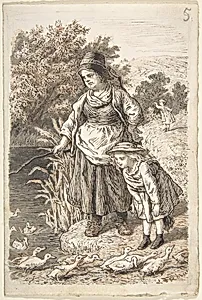
Woman and Child by a Duck Pond
1835–1903
Medium
Pen and dark brown and reddish-brown ink, brush and gray wash over graphite underdrawing
Dimensions
7 3/16 x 4 13/16 in. (18.2 x 12.2 cm)
Classification
Drawings
Department
Drawings and Prints
Museum
Metropolitan Museum of Art, New York, NY
Credit
Gift of Lincoln Kirstein, 1966
Accession Number
66.576.10(7)
Rights
Public Domain
Tags
Art Historical Context
Lorenz Frølich’s “Woman and Child by a Duck Pond” offers an intimate glimpse into a quiet moment of everyday life. Created between 1835 and 1903, this delicate drawing captures a woman and young girl standing at the edge of a pond, their attention drawn to the ducks gliding across the water. The small scale—just over seven by four inches—invites close viewing, encouraging visitors to appreciate the tender interaction between figures and nature. Frølich employed a refined combination of pen and ink with gray wash over graphite underdrawing. The layered technique allows for both precise outlines and soft tonal effects, giving the scene a lively yet gentle atmosphere. Dark brown and reddish-brown inks add subtle warmth, while the wash creates depth in the foliage and reflections on the water. Now part of the Metropolitan Museum’s collection of drawings and prints, the work highlights the 19th-century interest in natural, unpretentious subjects. Its gift by Lincoln Kirstein in 1966 ensures that this charming study of childhood curiosity and simple outdoor pleasures remains accessible to new generations of viewers.
About the Artist
Lorenz Frølich · 1820–1908
**Lorenz Frølich (1820–1908) was a Danish painter, illustrator, graphic artist, and etcher whose career bridged traditional academic training with a celebrated international reputation for book illustration.** Born into a wealthy bourgeois family in Copenhagen on 25 October 1820, he showed an early talent for drawing. He received private instruction from Martinus Rørbye starting in 1833, and later...