
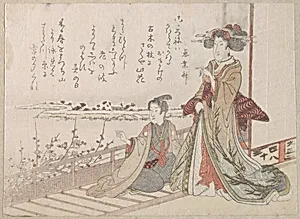
Woman and Youth on a Verandah
Medium
Part of an album of woodblock prints (surimono); ink and color on paper
Dimensions
5 5/16 x 7 5/16 in. (13.5 x 18.6 cm)
Classification
Prints
Culture & Period
Japan · Edo period (1615–1868)
Department
Asian Art
Museum
Metropolitan Museum of Art, New York, NY
Credit
H. O. Havemeyer Collection, Bequest of Mrs. H. O. Havemeyer, 1929
Accession Number
JP2298
Rights
Public Domain
Tags
Art Historical Context
Created in 1806 during Japan’s period, *Woman and on a Verand* belongs to the refined tradition of surimono—privately commissioned woodblock prints that combined delicate imagery with poetry. These small, luxurious sheets were typically produced in limited numbers for New Year greetings or special occasions, distinguishing them from more widely circulated ukiyo-e prints. The unidentified artist employed the meticulous woodblock technique, layering ink and color on paper to achieve subtle tonal effects within the compact format of roughly 5 by 7 inches. The scene of a woman and youth seated on a verandah evokes the quiet domestic moments and seasonal awareness prized in Edo-period culture. Such compositions often alluded to literary themes or the gentle rhythms of daily life, inviting viewers to pause and reflect. As part of an album, the print would have been appreciated in intimate settings, its fine details rewarding close examination. Today in the Metropolitan Museum of Art’s collection, this work preserves the elegance of early nineteenth-century Japanese printmaking and offers a glimpse into the refined visual poetry of its time.