
Woman Arranging Her Hair
1894
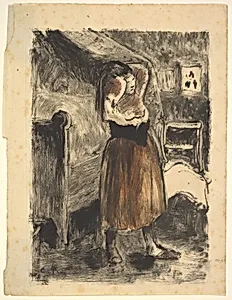
Medium
Monotype in black and red inks on wove paper
Dimensions
sheet: 8 1/16 x 6 1/8 in. (20.4 x 15.5 cm) plate: 7 x 4 15/16 in. (17.8 x 12.5 cm)
Classification
Prints
Department
Drawings and Prints
Museum
Metropolitan Museum of Art, New York, NY
Credit
Harris Brisbane Dick Fund, 1947
Accession Number
47.90.4
Rights
Public Domain
Tags
About this artwork
This intimate monotype presents a woman engaged in the quotidian activity of arranging her hair, captured with the immediacy and informal composition characteristic of Impressionist depictions of modern life. Pissarro renders the figure with loose, expressive marks that suggest form and gesture rather than delineating precise details, creating an image that balances observation with artistic interpretation. The use of black and red inks creates chromatic variety while maintaining the monochromat...
Art Historical Context
In Camille Pissarro's *Woman Arranging Her Hair* (1894), we glimpse an intimate moment of everyday life: a woman tending to her toilette with casual grace. As a founding father of Impressionism (1830–1903), Pissarro championed scenes from modern bourgeois existence, shunning grand historical or mythological themes for these unguarded, contemporary vignettes. Created late in his career, this small-scale work—measuring just 8 1/16 x 6 1/8 inches on wove paper—captures the movement's signature spontaneity through loose, expressive marks that evoke gesture over precise detail. This monotype, printed in black and red inks, showcases Pissarro's bold experiments in printmaking, inspired by Edgar Degas. The technique involves painting directly on a smooth plate (here, 7 x 4 15/16 inches), then pressing it onto paper for a unique impression—blending drawing's freedom with print's reproducibility. The subtle chromatic play of inks adds warmth and variety to the monochromatic form, highlighting Pissarro's versatility beyond his famed oil landscapes. Housed in the Metropolitan Museum of Art's Drawings and Prints department since 1947 (via the Harris Brisbane Dick Fund), this piece underscores Impressionism's innovative spirit and Pissarro's lifelong quest to refresh artistic traditions through new media and subjects. A charming window into 19th-century domesticity, it invites us to appreciate the beauty in the ordinary.
About the Artist
Camille Pissarro · 1831–1903
Camille Pissarro (1830-1903) stands as the patriarch of Impressionism, the only artist to exhibit in all eight Impressionist exhibitions and a mentor whose influence shaped the trajectory of modern art. Born Jacob Abraham Camille Pissarro on the Caribbean island of St. Thomas to a Jewish-Portuguese merchant family, he abandoned the family business to pursue painting, eventually settling in Paris i...