
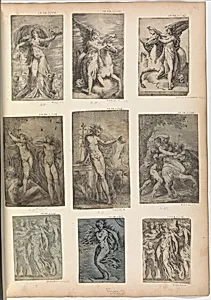
Woman Extending Her Right Arm Towards an Altar
16th century
Medium
Etching
Classification
Prints
Department
Drawings and Prints
Museum
Metropolitan Museum of Art, New York, NY
Credit
Harris Brisbane Dick Fund, 1927
Accession Number
27.78.2(110)
Rights
Public Domain
Tags
Art Historical Context
In the 16th century, during the height of the Renaissance, printmaking flourished as artists like the enigmatic Master F. P. used etching to create intricate, reproducible works that spread ideas across Europe. This etching *Woman Extending Her Right Arm an Altar*, exemplifies the medium's early mastery. Etching involves drawing into a wax ground on a metal plate with acid biting the lines, allowing for fluid, expressive strokes that differ from the rigid precision of engraving—making it ideal for dynamic mythological scenes. The composition draws viewers into a dramatic moment: a woman reaches toward an altar, surrounded by male nudes, Pegasus, and ritualistic elements suggested by the tags. These motifs evoke classical antiquity, blending human emotion with mythical symbolism—perhaps a scene of sacrifice or divine invocation. Master F. P., likely a Northern European anonymous artist, captured the era's fascination with the nude body and pagan lore, bridging Italian Renaissance ideals with Northern detail-oriented styles. Housed in the Metropolitan Museum of Art's Drawings and Prints department (Harris Brisbane Dick Fund, 1927), this print highlights etching's role in democratizing art, letting collectors own sophisticated imagery without originals. Its survival offers a window into 16th-century imagination, where gods, heroes, and rituals intertwined in bold, etched lines.