
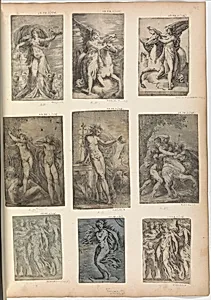
Pegasus Crowned by a Muse
Medium
Etching
Classification
Prints
Department
Drawings and Prints
Museum
Metropolitan Museum of Art, New York, NY
Credit
Harris Brisbane Dick Fund, 1927
Accession Number
27.78.2(106)
Rights
Public Domain
Tags
Art Historical Context
Behold *Pegasus Crowned by a Muse*, a captivating etching attributed to the Venetian Mannerist artist Andrea Schiav (Andrea Meldola), active in the 16th century, or possibly an anonymous Italian contemporary. Created through the innovative etching technique—where acid bites into a metal plate to create intricate lines—this print exemplifies the Renaissance fascination with classical mythology. Pegasus, the mythical winged horse born from Medusa's blood and tamer of poetic inspiration, is tenderly crowned by one of the Muses, goddesses of the arts, evoking themes creativity and divine patronage. Schiavone, influenced by masters like Titian and Parmigianino, brought a graceful, elongated elegance to his Mannerist figures, blending Venetian coloristic warmth with precise printmaking. Etchings like this allowed artists to disseminate elaborate designs widely, bridging painting and graphic arts during a time when humanism revived ancient tales. Though the exact date remains unknown, its style aligns with mid-16th-century Italy, when prints became prized collector's items. Housed in the Metropolitan Museum of Art's Drawings and Prints department, thanks to the Harris Brisbane Dick Fund of 1927, this work invites visitors to ponder the eternal muse-artist bond. Gaze closely at the fluid lines and poised forms, and feel the spark of inspiration that Pegasus embodies.
About the Artist
Andrea Schiavone (Andrea Meldola)|Anonymous, Italian?, 16th century · 1510–1563
Andrea Schiavone, born Andrea Meldolla around 1510 or 1515 in Zara (modern Zadar, Croatia), in Venetian-ruled Dalmatia, hailed from a family rooted in Meldola near Forlì in Romagna, Emilia-Romagna. His father, Simon Meldolla, served as a garrison commander there, and both parents originated from Meldola, where the family held property into the early 16th century. Nicknamed "Schiavone"—"the Slav"—a...