
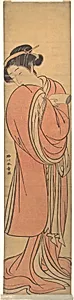
Woman in Red
late 18th century
Medium
Woodblock print (nishiki-e); ink and color on paper
Dimensions
27 7/8 x 6 1/2 in. (70.8 x 16.5 cm)
Classification
Prints
Culture & Period
Japan · Edo period (1615–1868)
Department
Asian Art
Museum
Metropolitan Museum of Art, New York, NY
Credit
H. O. Havemeyer Collection, Bequest of Mrs. H. O. Havemeyer, 1929
Accession Number
JP1760
Rights
Public Domain
Tags
Art Historical Context
Katsukawa Shunshō *Woman in Red*, a stunning woodblock print from the late 18th, captures the elegance of Edo-period Japan during the vibrant ukiyo-e ("pictures of the floating world"). As a master of the Katsukawa school, Shunsh was renowned for his bijin-ga—depictions of beautiful women—and actor portraits, blending realism with idealized beauty. This vertical ōban-sized print (27 7/8 x 6 1/2 in.), housed in the Metropolitan Museum of Art's Asian Art Department, showcases a poised woman in a striking red kimono, embodying the fashionable courtesans or urban sophisticates of Edo (modern Tokyo). The medium, nishiki-e or "brocade pictures," highlights Shunshō's mastery of multi-block color woodblock printing, a technique that layered vibrant inks on paper for rich, textured hues. Invented earlier in the century, it allowed unprecedented detail in fabrics, patterns, and expressions, making art accessible to the merchant class. The bold red garment, rendered with subtle gradations, draws the eye, reflecting seasonal trends and the era's obsession with transient beauty. Culturally, this print reflects Edo Japan's thriving urban culture amid the Tokugawa shogunate's stability (1615–1868). Part of the H. O. Havemeyer Collection, it offers a window into women's roles in the "floating world" of pleasure quarters, where fashion and poise signaled status. A timeless celebration of grace and artistry.
About the Artist
Katsukawa Shunshō 勝川春章 (Japanese) · 1726 –1792
Japanese, 1726–1792