
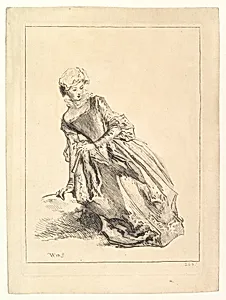
Woman leaning to left
Medium
Etching
Dimensions
Sheet: 11 5/16 x 8 5/16 in. (28.7 x 21.1 cm) Plate: 9 7/8 x 7 1/16 in. (25.1 x 18 cm)
Classification
Prints
Department
Drawings and Prints
Museum
Metropolitan Museum of Art, New York, NY
Credit
Gift of Georgiana W. Sargent, in memory of John Osborne Sargent, 1924
Accession Number
24.63.1083
Rights
Public Domain
Tags
Art Historical Context
In the elegant world of early 18th-century French Rococo art, *Woman Leaning to Left* stands as a delicate etching by François Boucher after Antoine Watteau, created between 1722 and 1728. Watteau, a master of the fêtes galantes style with its dreamy, theatrical scenes of courtship and leisure, profoundly influenced Boucher, his younger contemporary. This print likely reproduces one of Watteau's fluid figure studies, capturing a graceful woman in a poised, leaning pose that evokes the playful sensuality of the Rococo era—just as France transitioned from the grandeur of Louis XIV to the lighter, more intimate aesthetics of the Regency period under the Duc d'Orléans. Etching, Boucher's chosen medium here, allowed for intricate line work etched into a copper plate with acid, producing rich tonal variations and exquisite detail on a modest scale (plate: 9⅞ × 7¹⁄₁₆ in.). Prints like this were vital for disseminating Watteau's innovative style after his untimely death in 1721, making high art accessible to collectors and enthusiasts. Donated to the Metropolitan Museum of Art in 1924, this work exemplifies the collaborative spirit of Rococo printmaking, blending Watteau's poetic elegance with Boucher's precise technique—a charming glimpse into an age of refined frivolity.
About the Artist
François Boucher|Antoine Watteau · 1703–1770
François Boucher (1703–1770) stands as the quintessential master of French Rococo painting and the most celebrated decorative artist of the 18th century. Born in Paris to a lace designer, Boucher created a visual language that perfectly embodied the refined taste, sensuality, and elegance of Louis XV's court. His prolific output—encompassing paintings, tapestry designs, theatrical sets, and decora...