
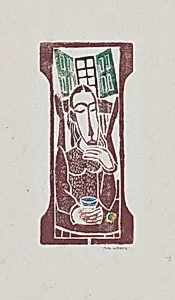
Woman Seated at Table
1919-1920
Medium
color woodcut on wove paper
Dimensions
image: 10.64 × 4.92 cm (4 3/16 × 1 15/16 in.) sheet: 25.56 × 16.99 cm (10 1/16 × 6 11/16 in.) mount: 27.94 × 17.78 cm (11 × 7 in.)
Classification
Department
CG-W
Museum
National Gallery of Art, Washington, D.C.
Credit
Gift of Jack and Margrit Vanderryn
Accession Number
2015.114.12
Rights
Public Domain
Art Historical Context
In the intimate "Woman Seated at Table created by Max Weber between 9 and 1920 we encounter a modernist gem rendered in color woodcut on wove. This diminutive print—measuring just 10.64 × 4.92 cm—captures a quiet domestic moment, evoking the everyday poetry of early 20th-century life. Housed in the National Gallery Art as a generous gift from Jack and Margrit Vanderryn, it exemplifies Weber's exploration of printmaking amid the vibrant New York art scene. Max Weber, a Russian-born Jewish immigrant who became a pivotal figure in American modernism, drew from Cubism, Expressionism, and his cultural heritage. By 1919, post-World War I, artists like Weber embraced woodcuts for their bold, graphic power. This labor-intensive medium involves carving multiple wood blocks for layered colors and crisp lines, echoing Japanese ukiyo-e influences that captivated Western modernists. Weber's technique yields flattened forms and rhythmic patterns, transforming a simple seated figure into a study of light, shadow, and emotional depth. This rare print highlights Weber's versatility beyond painting, bridging fine art and accessibility. Its small scale invites close contemplation, reminding us how modernism infused ordinary scenes with profound artistic innovation. A must-see for print enthusiasts!
About the Artist
Max Weber · 1881–1961
Max Weber (1881–1961), born in Białystok in the Russian Empire (now Poland) to Orthodox Jewish parents, immigrated to Brooklyn, New York, at age ten with his family, joining his tailor father.) There, he pursued art studies at the Pratt Institute under Arthur Wesley Dow, an innovative teacher who emphasized expression and form over traditional narrative, drawing from Japanese art and Paul Gauguin....