
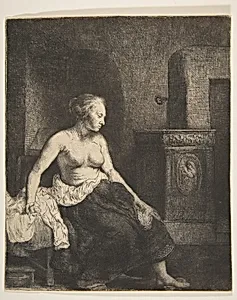
Woman Sitting Half-Dressed beside a Stove
Medium
Etching, burring, and drypoint; sixth of seven states
Dimensions
Sheet (Trimmed): 9 1/16 × 7 3/4 in. (23 × 19.8 cm)
Classification
Prints
Department
Drawings and Prints
Museum
Metropolitan Museum of Art, New York, NY
Credit
Gift of Albert E. McVitty, 1924
Accession Number
24.74
Rights
Public Domain
Tags
Art Historical Context
In 1658, Rembrandt van Rijn, the Dutch Baroque master renowned for his profound psychological depth and luminous chiaroscuro, created *Woman Sitting Half-Dressed a Stove*. This etching captures a nude woman in a cozy domestic interior, seated by a glowing hearth, embodying Rembrandt's fascination with everyday life and the human form. Produced during his later years, when he faced personal and financial hardships, the work reflects his innovative printmaking prowess amid the Dutch Golden Age's flourishing graphic arts. Rembrandt executed this piece using etching, burin, and drypoint techniques on a modest sheet (9 1/16 × 7 3/4 in.), reaching the sixth of seven states—a testament to his iterative process. Each state involved reworking the copper plate, adding rich, velvety textures through drypoint burrs that create dramatic light effects and tactile warmth, evoking the stove's heat on the woman's skin. Housed in the Metropolitan Museum of Art's Drawings and Prints department (Gift of Albert E. McVitty, 1924), it exemplifies how prints democratized art, allowing broader access to Rembrandt's genius beyond paintings. This evocative nude blends sensuality with vulnerability, inviting viewers into a private moment and highlighting Rembrandt's enduring influence on portraiture and genre scenes. A must-see for print enthusiasts!
About the Artist
Rembrandt (Rembrandt van Rijn) · 1606–1669
Rembrandt Harmenszoon van Rijn (1606–1669) stands as one of the greatest visual artists in the history of Western art and the most important Dutch painter of the 17th century. Born in Leiden to a prosperous miller's family, Rembrandt transformed painting through his revolutionary use of light and shadow, his psychological depth in portraiture, and his elevation of etching to a fine art. His approx...