
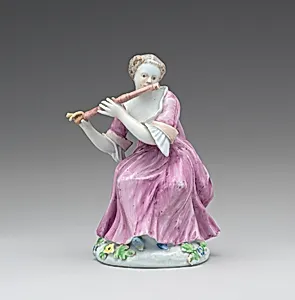
Woman with a flute
ca. 1755
Medium
Soft-paste porcelain
Dimensions
Height: 5 7/8 in. (14.9 cm)
Classification
Ceramics-Porcelain
Culture
British, Longton Hall, Staffordshire
Department
European Sculpture and Decorative Arts
Museum
Metropolitan Museum of Art, New York, NY
Credit
Gift of R. Thornton Wilson, in memory of Florence Ellsworth Wilson, 1943
Accession Number
43.100.28
Rights
Public Domain
Tags
Art Historical Context
In the mid-18th century, Longton Hall porcelain factory in Staffordshire, England, emerged as a pioneering British venture in the competitive world of European ceramics. Active from around 1750 to 1760, it specialized in soft-paste porcelain glassy, translucent material fired at lower temperatures than true hard-paste porcelain from Saxony's Meissen factory. *Woman with a Flute*, created circa 1755, exemplifies this innovation, standing just 5 7/8 inches tall and capturing a graceful female figure poised with her instrument. This delicate figurine reflects the Rococo taste for elegant, everyday scenes infused with whimsy and refinement. The woman, likely a pastoral musician, embodies the era's fascination with music and femininity in decorative arts. Longton Hall pieces like this were designed for affluent homes, adorning mantelpieces as conversation starters amid tea sets and vases. Though the factory's exact formulas were short-lived secrets, its output helped fuel Britain's porcelain boom, rivaling imports and showcasing national ingenuity. Today, gifted to the Metropolitan Museum of Art in 1943, this work highlights the cultural vibrancy of Georgian England, where affordable luxury democratized high art for the emerging middle class. Visitors can admire its fine modeling and subtle glaze, a testament to early industrial artistry.