
Woman's Accordian
1938
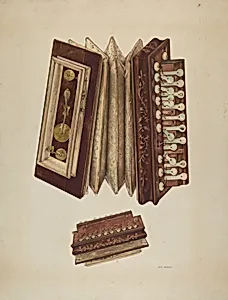
Medium
watercolor, graphite, and pen and ink on paper
Dimensions
overall: 59.9 x 45.4 cm (23 9/16 x 17 7/8 in.) Original IAD Object: 11 1/2" high; 5" wide (closed)
Classification
Index of American Design
Department
CG-W
Museum
National Gallery of Art, Washington, D.C.
Credit
Index of American Design
Accession Number
1943.8.12776
Rights
Public Domain
Art Historical Context
**Woman's Accordion** Created in 1938 by John Thorsen, *Woman's Accordion* is a captivating rendering from the Index of American Design, capturing the delicate charm of a petite musical instrument measuring just 11½ inches high and 5 inches wide when. Rendered in watercolor, graphite, pen and ink on paper (59.9 × 45.4 cm overall), Thorsen's work showcases the accordion's ornate bellows, pearl-inlaid keys, and feminine flourishes, evoking the elegance of early 20th-century parlor music. This piece emerged from the Index of American Design, a Works Progress Administration (WPA) project during the Great Depression that employed artists to document everyday American folk art and crafts. By preserving these objects through precise, vivid illustrations, the initiative celebrated the nation's cultural heritage amid economic hardship, ensuring that humble yet beautiful items like this lady's accordion—likely a novelty for home entertainment—were not lost to time. Thorsen's masterful use of mixed media brings texture and depth to the accordion's intricate details, blending soft watercolor washes with sharp ink lines for a lifelike quality. Housed in the National Gallery of Art, it invites visitors to appreciate how such designs reflected American ingenuity and leisure, bridging art, craft, and history in a single, harmonious fold.
About the Artist
John Thorsen · 1855–present
**John Thorsen (active c. 1935)** John Thorsen was an American artist active during the 1930s, best known for his contributions to the Index of American Design, a Federal Art Project under the Works Progress Administration (WPA). Little is documented about his early life, training, or formal artistic education, suggesting he may have been a self-taught practitioner whose skills aligned with the p...