
Woman's Ao (Short Robe)
Qing dynasty (1644–1911), 1870/90
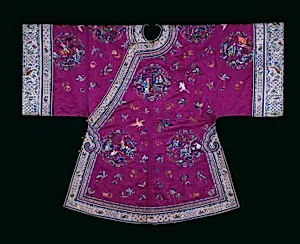
Medium
Silk, 7:1 satin damask weave; embroidered with silk and gold-leaf-over-lacquered-paper-strip-wrapped silk in knot, satin, and stem stitches; laid work and couching; sleeve bands: silk, warp-float faced 7:1 satin weave; embroidered with silk, gold-leaf-over-lacquered-paper-strip-wrapped wild silk, and gilt-metal-strip-wrapped silk in eyelet, feather, knot, satin, single satin, and stem stitches; laid work and couching; ribbons: silk and gold-leaf-over-lacquered-paper-strip-wrapped silk, complementary warp 7:1 satin weave with plain interlacings of secondary binding warps and self-patterning ground wefts; trim and closures: silk, warp-float faced 7:1 and 4:1 satin weaves; lined with silk, plain weave
Dimensions
109.5 × 145.1 cm (43 1/8 × 57 1/8 in.); Repeat: 10.8 × 9.2 cm (4 1/4 × 3 5/8 in.)
Classification
textile
Department
Textiles
Museum
Art Institute of Chicago
Accession Number
47257
Rights
Public Domain
Art Historical Context
This exquisite Woman's Ao, or short robe, crafted by Han-Chinese artisans during China's Qing dynasty (1644–1911) around 1870–90, exemplifies the pinnacle of late imperial textile artistry. Worn by women as an outer garment over skirts or trousers, the ao reflected evolving Manchu-influenced fashions among the Han elite, blending practicality with opulent display. Its deep blue silk ground, woven in a luxurious 7:1 satin damask pattern with a 10.8 × 9.2 cm repeat, evokes waves or clouds—motifs symbolizing harmony and prosperity. The robe's true marvel lies in its masterful embroidery: silk and gold-leaf-over-lacquered-paper-strip-wrapped threads in knot, satin, stem, eyelet, and feather stitches, enhanced by laid work and couching for a shimmering, three-dimensional effect. Sleeve bands and ribbons feature complementary warp satin weaves with self-patterning wefts, while silk linings and trims in 4:1 and 7:1 satins add subtle texture. Measuring 109.5 × 145.1 cm, this garment would have draped elegantly on a slender figure, showcasing the wearer's status through hours of skilled labor. Housed in the Art Institute of Chicago's Textiles Department, this ao highlights Qing-era innovations in silk production and goldwork, preserving a snapshot of everyday luxury amid dynastic decline. A testament to enduring Chinese craftsmanship!
About the Artist
Han-Chinese
**Han-Chinese** was the collective attribution given to anonymous artisans of Han Chinese descent who crafted intricate embroidered textiles during the Qing dynasty (1644–1911). These makers, active primarily in the late 18th to early 20th centuries, specialized in luxurious garments and furnishings that showcased the pinnacle of Han Chinese needlework traditions. Their early lives and individual ...