
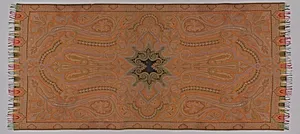
Woman's Long Shawl
1870s
Medium
Wool and cotton, warp threads dyed in multiple colors prior to weaving; center of warp-float faced 1:2 'Z' twill weave; patterned areas of two layers, plain weave and plain weave with seven-color complementary wefts, floats trimmed on reverse; knotted main warp fringe; woven on loom with Jacquard attachment; two selvages present
Dimensions
359.4 × 158.8 cm (141 1/2 × 62 1/2 in.)
Classification
textile
Department
Textiles
Museum
Art Institute of Chicago
Accession Number
151853
Rights
Public Domain
About this artwork
These boldly patterned shawls illustrate the broad appeal of the buta, or paisley, pattern. The Jacquard mechanism, a patterning technology introduced in the first decade of the 1800s, enabled European manufacturers to create increasingly complex variations on the paisley motif. Although this technology allowed for faster weaving, European companies never successfully reproduced the delicacy of the hand-woven shawls from Kashmir. British- and French-made shawls tended to be thicker and heavier a...
Art Historical Context
This exquisite *Woman's Long Shawl woven in the 1870s, the pinnacle of 19th-century textile innovation Crafted from wool and cotton, it measures an impressive 359.4 × 158.8 cm (141½ × 62½ in.), designed to elegantly drape over a woman's shoulders. The shawl's warp threads were dyed in multiple colors before weaving, creating a vibrant foundation for its intricate patterns. Produced on a loom with a Jacquard attachment—a groundbreaking 19th-century mechanism that automated complex designs—this piece reflects the era's blend of artistry and industrial ingenuity, allowing weavers to produce elaborate motifs with precision. At its heart lies a sophisticated center of warp-float faced 1:2 'Z' twill weave, transitioning into patterned areas of double-layered plain weaves. Here, seven-color complementary wefts interlock to form vivid designs, with floats meticulously trimmed on the reverse and finished with knotted fringe along the main warp. The presence of two selvages underscores its professional loom production. These techniques highlight the shawl's technical mastery, where color and texture interplay to evoke luxury and movement. Housed in the Art Institute of Chicago's Textiles Department, this anonymous masterpiece invites us to appreciate the unsung skill of textile artisans. In the 1870s, such shawls were cherished fashion staples, embodying cultural elegance and the democratizing power of Jacquard technology in everyday luxury.
About the Artist
Unknown
The artist designated as "Unknown" in our virtual museum's collection exemplifies a poignant chapter in art history: creators whose identities have faded into obscurity despite the enduring power of their work. With only one known artwork attributed to them in our holdings, this figure represents countless anonymous hands that shaped visual culture across centuries. Museums worldwide, including th...