
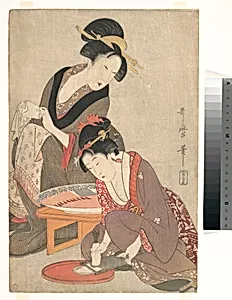
Women Preparing Sashimi
1806–20
Medium
Woodblock print; ink and color on paper
Dimensions
15 x 10 in. (38.1 x 25.4 cm)
Classification
Prints
Culture & Period
Japan · Edo period (1615–1868)
Department
Asian Art
Museum
Metropolitan Museum of Art, New York, NY
Credit
Rogers Fund, 1919
Accession Number
JP1122
Rights
Public Domain
Tags
Art Historical Context
In the vibrant world of Edo-period Japan (1615–1868), Kitagawa Utam's *Women Preparing Sashimi (ca. 1806–20) captures a serene domestic moment through the lens of ukiyo-e, the "pictures of the floating world" that celebrated everyday urban life. Utamaro, a master bijin-ga (images of beautiful women), portrays two elegant women deftly slicing raw fish for sashimi, their poised gestures reflecting the grace and skill of Japanese homemakers. This woodblock print, measuring a compact 15 x 10 inches, exemplifies the genre's focus on feminine beauty intertwined with daily rituals, from tea ceremonies to culinary arts. Crafted with ink and color on paper using the intricate woodblock technique—where separate blocks were carved for each hue and layer—Utamaro achieves luminous textures and subtle shading that bring the women's kimonos and the glistening fish to life. His innovative use of close-up compositions and soft, flowing lines elevated ukiyo-e from mere illustration to high art, influencing later masters like Hokusai. Housed in the Metropolitan Museum of Art's Asian Art collection (Rogers Fund, 1919), this print offers a window into Japan's culinary heritage and gender roles during a time of relative peace and prosperity. It reminds us how art preserved the poetry of the ordinary, turning sashimi preparation into a timeless tableau of harmony and precision.
About the Artist
Kitagawa Utamaro · 1753–1806
Kitagawa Utamaro (c. 1753-1806) was one of the most celebrated masters of ukiyo-e woodblock printing, revolutionizing the art of bijin-ga (pictures of beautiful women) during Japan's Edo period. Born Kitagawa Ichitaro, his early life remains shrouded in mystery, with conflicting accounts placing his birth in Kyoto, Osaka, Yoshiwara in Edo (modern Tokyo), or Kawagoe in Musashi Province. Under the t...