
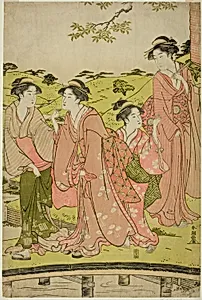
Women Visiting an Inari Shrine
c. 1780/1801
Medium
Color woodblock print; sheet of oban triptych (left: 1925.2708)
Dimensions
36.4 × 24.4 cm (14 5/16 × 9 9/16 in.)
Classification
woodblock print
Department
Arts of Asia
Museum
Art Institute of Chicago
Accession Number
22846
Rights
Public Domain
Art Historical Context
Katsukawa Shunchōactive 1780s–early 1800s), a master of the uki-e tradition from the renowned Katsukawa school, captures a serene moment in *Women Visiting an Inari* (c. 1780/1801). This vibrant color woodblock print, the left sheet of an oban triych, depicts elegant women in traditional kimonos approaching the fox-guarded shrine of Inari the Shinto deity of rice, prosperity, and foxes. Created during Japan's Edo period, it reflects the "floating world" of urban leisure and pilgrimage, where such visits blended devotion with social outing amid torii gates and vermilion architecture. Shunchō's bijin-ga style—portraying beautiful women with graceful poise and intricate patterns—shines through fine woodblock carving and multi-block printing, layering vivid hues like crimson and gold for lifelike depth and texture. Oban size (36.4 × 24.4 cm) made these affordable yet luxurious prints popular among Edo's merchant class, democratizing art. Housed in the Art Institute of Chicago's Arts of Asia department, this piece offers a window into 18th-century Japanese culture, blending spirituality, fashion, and artistry in a timeless celebration of femininity and faith.
About the Artist
Katsukawa Shunchô · 1780–1801
Katsukawa Shunchō was a Japanese designer of ukiyo-e woodblock prints active from approximately 1780 to 1795, one of the most graceful practitioners of the art of bijinga — pictures of beautiful women. He trained in the studio of Katsukawa Shunshō, the founding master of the Katsukawa School, whose pupils also included the young Hokusai. Shunshō's school was primarily known for realistic portraits...