
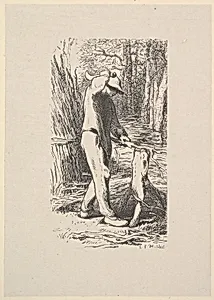
Woodcutter Making a Faggot
Medium
Woodcut on chine collé
Dimensions
block: 5 5/16 x 2 15/16 in. (13.5 x 7.5 cm)
Classification
Prints
Department
Drawings and Prints
Museum
Metropolitan Museum of Art, New York, NY
Credit
Harris Brisbane Dick Fund, 1927
Accession Number
27.81.2(40)
Rights
Public Domain
Tags
Art Historical Context
In the serene yet laborious scene of *Woodcutter Making aaggot* (1853), Jean-François Millet and Jacques-Adrien Lavieille capture the quiet dignity of rural toil. Created as a woodcut on chine collé—a technique where delicate Chinese paper is adhered to a sturdy support for finer detail and subtlety—this intimate print (5 5/16 x 2 15/16 in.) depicts lone woodcutter bundling branches into a faggot, surrounded by trees that frame his focused effort. Millet, a pioneer of Realism and the Barbizon school, often celebrated the everyday lives of peasants, elevating manual labor to subjects of profound artistic merit. This collaboration highlights the era's innovative printmaking, where Millet's painterly vision met Lavieille's precise engraving skills. Woodcuts, typically bold and graphic, gain nuance here through chine collé, allowing subtle tones and textures that evoke the dappled forest light. Produced amid France's mid-19th-century shift toward naturalism, the work reflects Romantic ideals of harmony with nature while foreshadowing Millet's iconic peasant scenes, like *The Gleaners*. Today, housed in the Metropolitan Museum of Art's Drawings and Prints department (Harris Brisbane Dick Fund, 1927), this print invites visitors to ponder the unsung rhythms of working life, blending technical mastery with empathetic observation.
About the Artist
Jean-François Millet|Jacques-Adrien Lavieille · 1814–1875
Jean-François Millet (1814-1875) was a French painter and one of the founders of the Barbizon school, whose dignified depictions of peasant laborers transformed how art could represent rural life. His monumental images of sowers, gleaners, and field workers elevated common people to subjects previously reserved for mythological or historical figures, making him a pivotal figure in the development ...