
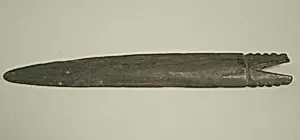
Wooden Weaving Sword
Unknown Artist
before 16th century
Medium
Wood
Dimensions
H. 6 3/8 × W. 7/8 in. (16.2 × 2.2 cm)
Classification
Wood-Implements
Culture
Peruvian
Department
Arts of Africa, Oceania, and the Americas
Museum
Metropolitan Museum of Art, New York, NY
Credit
Gift of Mr. and Mrs. Nathan Cummings, 1964
Accession Number
64.228.753
Rights
Public Domain
Art Historical Context
This slender Wooden Weaving Sword, crafted from wood before the 16th century, hails from ancient Peru and exemplifies the everyday tools of pre-Columbian artisans. Measuring just 6 3/8 inches long 7/8 inch wide, its compact, ergonomic form was designed for precision in backstrap loom weaving—a technique central to Andean textile production. Now housed in the Metropolitan Museum of's Department of Arts of Africa,, and the Americas, was generously gifted by Mr. and Mrs. Nathan Cummings in 1964. In Peruvian culture, weaving was far more than a craft; it was a revered art form symbolizing social status, cosmology, and community identity. Textiles often rivaled metalwork in value, with intricate patterns encoding myths and histories. This sword served as a beater and shuttle, packing weft threads tightly to create the fine, durable fabrics prized by Inca and earlier societies. Its smooth carving reflects skilled woodworking, adapted to the weaver's hand for hours of rhythmic labor. Though the artist remains unknown, this humble implement offers a window into the ingenuity of Peru's ancient fiber artists, reminding us how tools shaped some of the world's most sophisticated pre-Columbian textiles.