
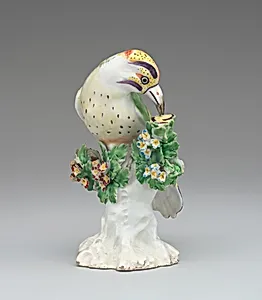
Woodpecker
ca. 1765
Medium
Soft-paste porcelain
Dimensions
Overall: 5 1/4 × 3 1/2 in. (13.3 × 8.9 cm)
Classification
Ceramics-Porcelain
Culture
British, Derby
Department
European Sculpture and Decorative Arts
Museum
Metropolitan Museum of Art, New York, NY
Credit
Gift of Irwin Untermyer, 1964
Accession Number
64.101.765
Rights
Public Domain
Tags
Art Historical Context
In the mid-18th century, Derby Porcelain Manuf in England produced exquisite small-scale figures like this charming *Woodpecker* (ca. 1765), crafted from soft-paste porcelain. Standing just 5¼ × 3½ inches, this delicate bird captures the factory's mastery of naturalistic modeling, with finely detailed feathers, beak, and perky posture that bring the woodland creature to life. Derby, often linked to the Chelsea-Derby period, rivaled European leaders like Meissen by imitating high-end Chinese and German porcelains while infusing British whimsy. Soft-paste porcelain, a key innovation before true hard-paste formulas were perfected, blended clay with ground glass and fired at lower temperatures, allowing vibrant overglaze colors and intricate gilding. These techniques made Derby's animal figures—especially birds—coveted status symbols for affluent homes, blending utility as mantel ornaments with artistic delight. This piece exemplifies the era's Rococo fascination with nature, where everyday wildlife became elegant decor. Today, housed in the Metropolitan Museum of Art thanks to a 1964 gift from Irwin Untermyer, the *Woodpecker* highlights Derby's role in elevating British ceramics to fine art, inviting visitors to appreciate the playful precision of 18th-century craftsmanship.
About the Artist
Derby Porcelain Manufactory · 1751–1785
The Derby Porcelain Manufactory stands as one of the foundational institutions of British ceramic art, producing some of the finest figures and tablewares made in England during the eighteenth and early nineteenth centuries. Its origins can be traced to the work of André Planché, a Huguenot immigrant from Saxony who settled in Derby around 1745 and began producing soft-paste porcelain figures and ...