
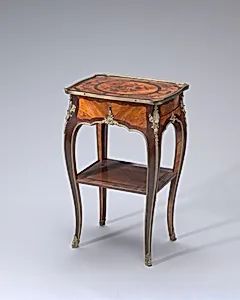
Work and Writing Table (table en chiffonnière)
c. 1750/1760
Medium
veneered partly on oak and partly on pine with tulipwood, purplewood, crosscut kingwood, and casuarina; gilded bronze mounts
Dimensions
overall: 66.8 x 42 x 32 cm (26 5/16 x 16 9/16 x 12 5/8 in.)
Classification
Decorative Art
Department
CSD
Museum
National Gallery of Art, Washington, D.C.
Credit
Widener Collection
Accession Number
1942.9.420
Rights
Public Domain
Art Historical Context
Step into the opulent world of 18th-century French interiors with this exquisite *Work and Writing Table (table en chiffonnière)* by Bernard Vanrisamburgh II, a master Parisian cabinetmaker (ébéniste) active around 1750–1760. Crafted during the lavish Louis XV era, when Rococo style reigned supreme, this compact piece (just 66.8 x 42 x 32 cm) embodies the period's love for elegance, asymmetry, and playful curves. Vanrisamburgh II, whose stamped works graced royal and aristocratic homes, specialized in such multifunctional furniture—perfect for a lady's boudoir, blending a writing surface with discreet storage drawers. The table's artistry shines in its intricate marquetry veneer, applied over oak and pine carcasses using exotic woods like tulipwood, purplewood, crosscut kingwood, and casuarina. These create vibrant, patterned surfaces that mimic floral or geometric motifs, a hallmark of high-end Parisian craftsmanship. Gilded bronze mounts—delicate hardware with rocaille designs—add a touch of shimmering luxury, elevating the piece from functional object to sculptural jewel. Part of the Widener Collection at the National Gallery of Art, it reflects the era's fusion of utility and splendor, where everyday tasks became occasions for refinement. This table invites us to imagine powdered wigs and candlelit correspondence, a testament to France's golden age of decorative arts.