
Writing table
ca. 1760–70
Medium
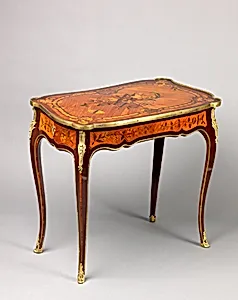
Oak veneered with tulipwood, mahogany, and rosewood, with marquetry of partly shaded satinwood, partly stained, shaded, and engraved maple and barberry, and ebonized wood; gilt-bronze mounts.
Dimensions
H. 71.1 cm, W. 80.7 cm, D. 47 cm
Classification
Woodwork-Furniture
Culture
French, Paris
Department
Robert Lehman Collection
Museum
Metropolitan Museum of Art, New York, NY
Credit
Robert Lehman Collection, 1975
Accession Number
1975.1.2031
Rights
Public Domain
Art Historical Context
This elegant writing table, crafted by Parisian ébéniste Christophe Wolff around 1760–70, exemplifies the refined craftsmanship of late Louis XV and early Louis XVI furniture from France. During this transitional period in Parisian workshops, makers like Wolff blended the playful curves of Rococo with emerging Neoclassical restraint, creating pieces for the aristocracy's private studies. As a bureau plat, it served as a functional yet luxurious desk for correspondence and scholarly pursuits, reflecting the Enlightenment-era emphasis on intellectual refinement. The table's construction showcases virtuoso techniques: an oak carcass veneered in exotic tulipwood, mahogany, and rosewood, adorned with intricate marquetry inlays of shaded satinwood, stained and engraved maple, barberry, and ebonized wood. These floral and geometric motifs, achieved through precise cutting and shading, mimic painting on wood—a hallmark of Parisian luxury furniture. Gilt-bronze mounts add opulent detailing, elevating the piece's status as a status symbol for elite collectors. Now in the Robert Lehman Collection at The Metropolitan Museum of Art, this 71 cm high table (80.7 cm wide, 47 cm deep) invites visitors to appreciate the fusion of utility, artistry, and opulence that defined 18th-century French design.