
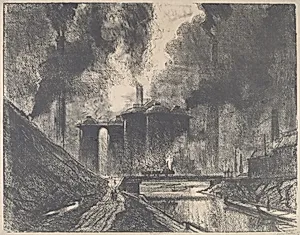
Work Castles, Wolverhampton
1912
Medium
lithograph
Classification
Department
CG-W
Museum
National Gallery of Art, Washington, D.C.
Credit
Rosenwald Collection
Accession Number
1943.3.6924
Rights
Public Domain
Art Historical Context
Joseph Pennell's *Work Castles, Wolver* (1912) is a striking lithograph capturing the monumental ironworks of England's Black Country, a hub of industrial might during the Edwardian era. Pennell, an acclaimed American printmaker and etcher (1857–1926), was renowned for his dramatic depictions of architecture and industry, often produced during his extensive travels across Europe with his wife and fellow artist, Elizabeth Robins Pennell. print exemplifies his fascination with the sublime scale of factories, transforming hulking smokestacks and foundries—nicknamed "work castles" for their fortress-like grandeur—into symbols of human ingenuity and progress. Created as a lithograph, the work leverages the medium's unique strengths: Pennell's fluid crayon strokes on limestone allowed for rich tonal contrasts, intricate details, and atmospheric depth, mimicking the haze of coal smoke and glowing furnace light. Lithography, popularized in the 19th century, enabled artists like Pennell to produce affordable yet exquisite editions, bridging fine art and public appreciation. Housed in the National Gallery of Art's Rosenwald Collection—a treasure trove of master prints—this piece reflects early 20th-century awe for industrialization, just before World War I reshaped such landscapes forever. Visitors will appreciate how Pennell's keen eye elevates gritty machinery into poetry, inviting reflection on industry's beauty and burden. (198 words)
About the Artist
Joseph Pennell · 1857–1926
Joseph Pennell (1857–1926) was born in Philadelphia to Quaker parents and displayed an early aptitude for drawing, finding solace in sketching amid a challenging childhood. He received initial drawing instruction from James R. Lambdin and his first etching lessons from Stephen Ferris in 1879. Pennell attended night classes at the Pennsylvania Museum and School of Industrial Art before studying at ...