
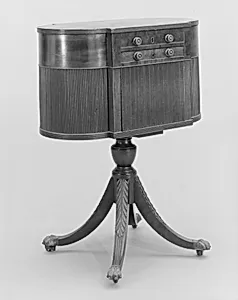
Work Table
1805–15
Medium
Mahogany, maple, white pine, gilt brass
Dimensions
31 7/8 x 21 x 13 5/8 in. (81 x 53.3 x 34.6 cm)
Classification
Work table
Culture
American
Department
The American Wing
Museum
Metropolitan Museum of Art, New York, NY
Credit
Gift of C. Ruxton Love Jr., 1960
Accession Number
60.4.16
Rights
Public Domain
Art Historical Context
Nestled in The American Wing of the Metropolitan Museum of Art, Duncanfe's *Work Table* (1805–15) exemplifies refined craftsmanship of early 19th American furniture making. Crafted from luxurious mahogany—the prized imported hardwood symbolizing status—with maple and white pine for structural support, and accented by gleaming gilt brass hardware, this compact piece measures just 31 7/8 x 21 x 13 5/8 inches, perfect for intimate domestic use. Phyfe, a Scottish-born master cabinetmaker based in New York, drew from neoclassical influences like the French Directoire and Empire styles, blending them with American practicality. His workshop's signature reeded legs, delicate carving, and balanced proportions made his designs coveted by the emerging urban elite during the young republic's Federal period. Work tables like this served as multifunctional ladies' desks for sewing, writing letters, or light tasks, reflecting the era's ideals of refined leisure. A generous gift from C. Ruxton Love Jr. in 1960, this table highlights Phyfe's pivotal role in elevating American furniture to international standards, bridging European elegance with Yankee ingenuity. Visitors will appreciate its timeless appeal, a snapshot of genteel life in post-Revolutionary America.
About the Artist
Duncan Phyfe · 1770–1854
Duncan Phyfe (1770–1854) was a Scottish-born American cabinetmaker who became the most celebrated furniture maker in the history of American decorative arts. Born Duncan Fife near Loch Fannich in the Scottish Highlands, he emigrated with his family to Albany, New York, around 1783–84, where he apprenticed to a cabinetmaker. By 1792 he had established his own workshop on Partition Street (later Ful...