
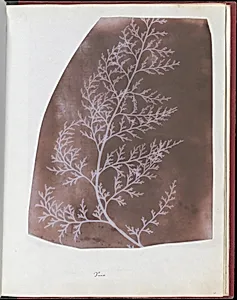
Wrack
Medium
Salted paper print
Dimensions
22 x 17.5 cm (8 11/16 x 6 7/8 in.), irregularly trimmed
Classification
Photographs
Department
Photographs
Museum
Metropolitan Museum of Art, New York, NY
Credit
Harris Brisbane Dick Fund, 1936
Accession Number
36.37 (25)
Rights
Public Domain
Tags
Art Historical Context
William Henry Fox Talbot's *Wrack* (1839) captures the intricate textures of seaweed—known as "wrack" washed ashore—in one of the earliest surviving photographs. This salted paper print, measuring 22 x 17.5 cm and irregularly trimmed, reveals Talbot's pioneering "photogenic drawing" technique, where light-sensitive paper directly recorded the subject's form without a camera lens in some cases. The delicate fronds and veined surfaces evoke a sense of scientific wonder, aligning with the era's fascination with botany and natural history. Created just months after the public announcement of photography in 1839, *Wrack* marks Talbot's breakthrough in the race to invent a practical photographic process, rivaling Louis Daguerre's daguerreotype. As a salted paper print—the first viable method for producing positive images from paper negatives— it laid the groundwork for modern photography. Talbot's calotype process, refined around this time, allowed multiple prints from a single negative, democratizing image-making. Housed in the Metropolitan Museum of Art, this work bridges art and science, inviting viewers to marvel at nature's hidden details frozen in time. Its modest scale and organic subject highlight photography's power to reveal the unseen, transforming a humble beach find into a landmark of visual history.
About the Artist
William Henry Fox Talbot · 1800–1877
William Henry Fox Talbot (1800–1877), a British polymath whose ingenuity transformed visual representation, was born on 11 February 1800 at Melbury House, Dorset, the only child of William Davenport Talbot of Lacock Abbey and Lady Elisabeth Fox Strangways, daughter of the 2nd Earl of Ilchester. His father died shortly after his birth, leaving the family in financial straits until his formidable mo...