
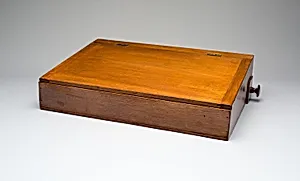
Writing Box
1825–60
Medium
Chestnut
Dimensions
11.5 × 46.4 × 32.5 cm (4 1/2 × 18 1/4 × 12 3/4 in.)
Classification
desk
Department
Arts of the Americas
Museum
Art Institute of Chicago
Accession Number
71948
Rights
Public Domain
Art Historical Context
Nestled in the Art Institute of Chicago's Arts of the collection, this unassuming Writing Box, crafted by Shaker hands between 1825 and 1860, embodies the essence of Shaker ingenuity. Made from chestnut—a durable, native American hardwood prized for its strength and subtle grain—this portable desk measures a compact 11.5 × 46.4 × 32.5 cm, perfect for traveling missionaries or community members jotting letters, keeping ledgers, or studying scripture. The Shakers, a celibate religious sect flourishing in communal villages across the northeastern U.S., rejected worldly excess in favor of spiritual purity, and their furniture reflects this ethos. Shaker design championed radical simplicity: clean lines, functional form, and flawless joinery without a single decorative flourish. This writing box exemplifies those principles, with its straightforward construction prioritizing utility over ornament—tapering legs for stability, a slanted lid for ergonomic writing, and likely interior compartments for ink, quills, and paper. Chestnut's warm patina has deepened over time, highlighting the Shakers' masterful woodworking techniques honed through communal workshops. Beyond its practicality, the piece holds cultural weight as a testament to Shaker innovation, influencing modern minimalism from the Bauhaus to Scandinavian design. Imagine a Shaker sister or brother unfolding this box by candlelight, their hands guided by the motto "Hands to work, hearts to God." A quiet marvel of 19th-century American craft.