
Wrought Iron Banister Bracket
c. 1937
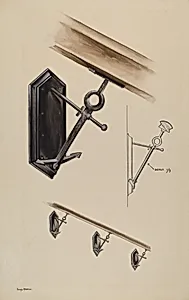
Medium
watercolor, pen and ink, gouache, and graphite on paperboard
Dimensions
overall: 50.8 x 32.4 cm (20 x 12 3/4 in.)
Classification
Index of American Design
Department
CG-W
Museum
National Gallery of Art, Washington, D.C.
Credit
Index of American Design
Accession Number
1943.8.16616
Rights
Public Domain
Art Historical Context
Behold the *Wrought Iron Banister Bracket*, a captivating 1937 rendering by artist James McLellan, part of the National Gallery of Art's esteemed Index of American Design collection. This mixed-media work on paperboard—measuring 20 x 12¾ inches—beautifully captures the elegant curves and sturdy craftsmanship of a classic wrought iron architectural element, likely from America's rich tradition of ornamental metalwork. McLellan's precise depiction highlights the bracket's functional beauty, evoking the hand-forged artistry of 18th- or 19th-century builders who adorned homes and public spaces with such durable, decorative supports. Created during the Great Depression as part of the Federal Art Project under the Works Progress Administration, the Index of American Design (1935–1942) commissioned artists like McLellan to document everyday American objects through vivid, accurate illustrations. Employing watercolor, pen and ink, gouache, and graphite, McLellan masterfully rendered the iron's textured surfaces, shadows, and intricate scrollwork, blending technical precision with artistic flair. This technique not only preserved vanishing folk arts but also celebrated the ingenuity of American design. Today, this piece invites us to appreciate how everyday hardware embodied cultural pride and skilled labor, bridging utility and ornament in our nation's architectural heritage. A testament to New Deal-era creativity, it reminds visitors of art's power to safeguard history.
About the Artist
James McLellan · 1855–present
James McLellan was an American artist active during the late 1930s, best known for his contributions to the Index of American Design (IAD), a New Deal-era Federal Art Project under the Works Progress Administration (WPA). Launched in 1935, the IAD commissioned artists across the United States to create precise watercolor renderings of everyday folk art and decorative objects, preserving a visual r...