
Wrought Iron Pot Hooks
c. 1938
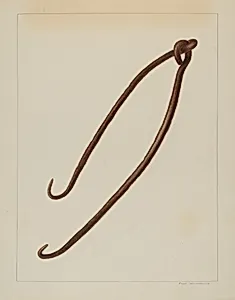
Medium
watercolor and graphite on paper
Dimensions
overall: 35.7 x 28.1 cm (14 1/16 x 11 1/16 in.)
Classification
Index of American Design
Department
CG-W
Museum
National Gallery of Art, Washington, D.C.
Credit
Index of American Design
Accession Number
1943.8.11517
Rights
Public Domain
Art Historical Context
Discover the intricate beauty of everyday American craftsmanship in *Wrought Iron Pot Hooks*, a meticulous 1938 watercolor and graphite rendering by artist Fred Hassebrock. This detailed study captures the elegant curves and functional strength of traditional wrought iron hooks, once essential for suspending pots over open hearths in colonial and early homes. Measuring 35.7 x 28.1 cm, the work showcases the object's forged textures and subtle patina with remarkable precision, inviting viewers to appreciate the blacksmith's artistry in utilitarian design. Created as part of the Index of American Design—a groundbreaking WPA Federal Art Project from 1935 to 1942—Hassebrock's piece contributes to a national effort to document and celebrate America's folk arts amid the Great Depression. Hundreds of artists like him produced over 18,000 renderings of historical objects, preserving cultural heritage for future generations. Housed in the National Gallery of Art, this watercolor highlights the medium's value: its luminous washes and fine graphite lines allowed for lifelike accuracy, bridging fine art with historical preservation. These pot hooks embody the ingenuity of early American life, where form met function in enduring ironwork. Through Hassebrock's skilled hand, we glimpse a vanishing world of hearth-centered domesticity, reminding us of our shared creative legacy.
About the Artist
Fred Hassebrock · 1903–1978
Fred Hassebrock is an artist for whom biographical documentation is very limited. No birth or death dates have been established, and his nationality and training are not recorded in major reference sources. His name does not appear prominently in standard art-historical surveys, and the specifics of his career — the schools he attended, the teachers who influenced him, the movements with which he...