
Jersey Pipe
c. 1930
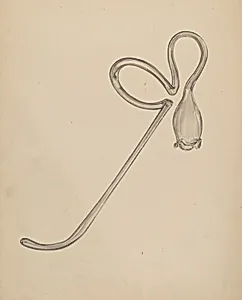
Medium
watercolor and graphite on paperboard
Dimensions
overall: 29.2 x 22.6 cm (11 1/2 x 8 7/8 in.)
Classification
Index of American Design
Department
CG-W
Museum
National Gallery of Art, Washington, D.C.
Credit
Index of American Design
Accession Number
1943.8.10862
Rights
Public Domain
Art Historical Context
Behold *Jersey Pipe*, a watercolor and graphite rendering by Francis Law Durand, created around 1930. This intimate work, measuring just 11½ × 8⅞ inches, meticulously captures the form and character of a traditional tobacco pipe linked to New Jersey folk traditions. Durand's precise graphite outlines paired with vibrant watercolors bring out the pipe's textured surface, carved details, and earthy tones, evoking the craftsmanship of early American artisans. As part of the Index of American Design—a groundbreaking WPA Federal Art Project from the 1930s—*Jersey Pipe* holds profound historical significance. Launched during the Great Depression, the Index employed artists like Durand to document everyday objects, folk art, and vernacular designs across America. These detailed studies preserved vanishing cultural treasures, celebrating the ingenuity of regional makers before mass production overshadowed them. Housed in the National Gallery of Art, it exemplifies how watercolor on paperboard allowed for accurate color reproduction and fine-line precision, making it an invaluable record of 19th-century American material culture. Today, this piece invites visitors to appreciate the humble beauty of utilitarian objects, reminding us of the diverse stories embedded in everyday artifacts from our nation's past.
About the Artist
Francis Law Durand · 1855–present
**Francis Law Durand (1906–1995)** Born on March 31, 1906, in Mount Holly, New Jersey, Francis Law Durand emerged as a skilled American draftsman and artist during the Great Depression era. Little is known about his early life or formal training, as biographical details remain sparsely documented beyond his professional output. By 1935, he was employed by the Works Progress Administration (WPA), ...