
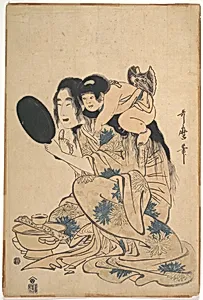
Yamauba Blackening her Teeth, with Kintarō
ca. 1795
Medium
Ink on mulberry paper
Dimensions
Oban: 14 3/4 x 9 3/4 in. (37.5 x 24.8 cm)
Classification
Prints
Culture & Period
Japan · Edo period (1615–1868)
Department
Asian Art
Museum
Metropolitan Museum of Art, New York, NY
Credit
Gift of John and Lili Bussel, 1996
Accession Number
1996.463
Rights
Public Domain
Tags
Art Historical Context
In the enchanting world of Edo-period Japan (1615–1868), Kitagawa Utamaro'sYamauba Blackening Teeth, with Kintō* (ca. 1795) captures a tender moment from folklore. This ukiyo-e woodblock, rendered in ink on traditional mulberry paper, depicts the mountain witch Yamauba—often portrayed as a fearsome yokai—gently caring for the superhuman boy Kintarō. Seated before a mirror, she applies ohaguro, the custom of blackening teeth with iron filings and vinegar, a rite signaling maturity and marital status among women of the time. Utamaro, a master of bijin-ga (images of beautiful women), infuses the scene with intimate warmth, highlighting the nurturing bond despite Yamauba's mythical wildness. Measuring oban size (14 3/4 x 9 3/4 in.), this print exemplifies ukiyo-e's "pictures of the floating world," celebrating everyday rituals and legends through precise lines and subtle shading. Mulberry paper's soft texture enhances the delicate interplay of light on the mirror and figures' expressive faces, drawing viewers into 18th-century Japanese domestic life. Kintarō, Japan's folk hero symbolizing strength and innocence, adds playful energy, making the work a bridge between myth and reality. Housed in the Metropolitan Museum of Art's Asian Art Department, this gift from John and Lili Bussel (1996) invites us to ponder enduring cultural practices like ohaguro, which persisted until the Meiji era, and Utamaro's genius for humanizing the supernatural. A delightful glimpse into Japan's vibrant print culture!
About the Artist
Kitagawa Utamaro · 1753–1806
Kitagawa Utamaro (c. 1753-1806) was one of the most celebrated masters of ukiyo-e woodblock printing, revolutionizing the art of bijin-ga (pictures of beautiful women) during Japan's Edo period. Born Kitagawa Ichitaro, his early life remains shrouded in mystery, with conflicting accounts placing his birth in Kyoto, Osaka, Yoshiwara in Edo (modern Tokyo), or Kawagoe in Musashi Province. Under the t...