
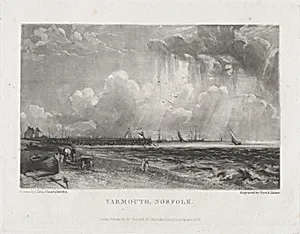
Yarmouth, Norfolk
Medium
Mezzotint; third state of six
Dimensions
Image: 5 1/2 × 8 5/8 in. (14 × 21.9 cm) Plate: 7 9/16 × 9 15/16 in. (19.2 × 25.2 cm) Sheet: 11 1/2 × 17 1/4 in. (29.2 × 43.8 cm)
Classification
Prints
Department
Drawings and Prints
Museum
Metropolitan Museum of Art, New York, NY
Credit
Harris Brisbane Dick Fund, 1925
Accession Number
25.51.8
Rights
Public Domain
Tags
Art Historical Context
"Yarmouth, Norfolk" (1832) is a captivating mezzotint print capturing the serene coastal beauty of Great Yarmouth in Norfolk England. Created through a close collaboration between landscape master John Constable and engraver David Lucas, it boats bobbing near piers against a vast seascape, evoking Constable's lifelong fascination with the interplay of sea, sky, and everyday maritime life. This work belongs to their ambitious series *Various Subjects of Landscape Characteristic English Scenery* (1830–1833), which aimed to translate Constable's luminous oil sketches into affordable prints for a wider audience. Mezzotint, a "dark manner" intaglio technique invented in the 17th century, excels at producing velvety blacks and subtle tonal gradations, mimicking the atmospheric effects of Constable's oil paintings. This is the third state of six, an intermediate proof showing refinements in shading and detail before final publication—offering visitors a glimpse into the meticulous printmaking process. Constable supervised Lucas closely, ensuring the prints retained his Romantic emphasis on nature's transient light and mood. Housed in The Metropolitan Museum of Art's Drawings and Prints department, this piece highlights 19th-century innovations in reproductive printmaking, making elite art accessible while preserving Constable's vision of England's romantic landscapes. Pause to admire how the rich tones draw you into the salty breeze of Yarmouth's shore.
About the Artist
David Lucas|John Constable · 1802–1881
**David Lucas (1802–1881)** David Lucas was born in 1802 in Geddington Chase, Northamptonshire, the son of a farmer.) A chance encounter in 1820 led him to become a pupil of the renowned engraver Samuel William Reynolds, under whom he apprenticed in London until 1827, mastering the art of mezzotint engraving.) By 1827, Lucas had published his first mezzotints, showcasing his precocious talent for...