
Yellow Shank
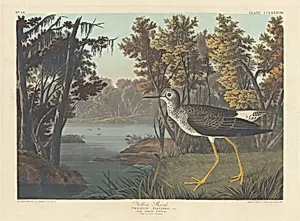
Medium
hand-colored engraving and aquatint on Whatman wove paper
Classification
Department
CG-W
Museum
National Gallery of Art, Washington, D.C.
Credit
Gift of Mrs. Walter B. James
Accession Number
1945.8.288
Rights
Public Domain
Art Historical Context
**Yellow Shank** (1836) is a captivating print from John James Audub monumental *The Birds of America*, one of the most ambitious natural history projects of the 19th century Created after Audubon's original watercolor by master engraver Robert Havell., it showcases a lesser-known shorebird—the Yellow Shank—in lifelike scale and dynamic pose. Audubon's innovative approach, blending artistic flair with scientific accuracy, departed from stiff, static illustrations, portraying birds in their natural habitats to educate and inspire awe. The artwork's medium—hand-colored engraving and aquatint on fine Whatman wove paper—highlights the era's printmaking mastery. Engraving provided intricate line details for feathers and anatomy, while aquatint added soft tonal gradations for realism. Artisans then applied vibrant colors by hand, ensuring each of the edition's prints glowed with individuality, a labor-intensive process that elevated these works to collector's treasures. Now in the National Gallery of Art's collection (gift of Mrs. Walter B. James, Department CG-W), *Yellow Shank* embodies the cultural fusion of Romanticism and emerging scientific inquiry. It invites visitors to marvel at Audubon's legacy, bridging art, nature, and exploration in early America.
About the Artist
Robert Havell after John James Audubon
Robert Havell Jr., born on November 25, 1793, in Reading, Berkshire, England, was the son of renowned engraver and publisher Robert Havell Sr. and Lydia Miller Phillips. Growing up in a family of artists that included notable engravers and etchers, he trained under his father, mastering aquatint techniques early on. Though briefly estranged from the family business, Havell reconciled with his fath...