
Yellowstone National Park
1873-1879
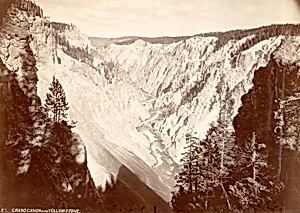
Medium
Photography-Photoprint
Classification
Photography-Photoprint
Department
Smithsonian Collection
Museum
Smithsonian American Art Museum
Credit
Smithsonian American Art Museum, Transfer from the Library of the Smithsonian American Art Museum and the National Portrait Gallery, Smithsonian Institution
Accession Number
1989.66.1.1-85
Rights
Public Domain
Tags
Art Historical Context
William H. Jackson's *Yellowstone National Park*1873-1879) captures the raw majesty of America's first national park through pioneering photography. As the official photographer for the U.S Geological Survey's expeditions in the 1870s, Jackson into Wyoming's untamed wilderness, documenting geysers, canyons, and geothermal wonders with his bulky large-format camera. This photoprint, part of the Smithsonian American Art's collection, exemplifies the's shift from painting to photography as a tool for exploration and public persuasion. Jackson's images played a pivotal role in conservation history, building on his earlier work that helped Congress establish Yellowstone in 1872. His technically demanding process—using glass negatives exposed in remote conditions—produced stunning, detailed prints that brought distant landscapes to urban audiences, fueling the national parks movement. These photographs weren't mere records; they romanticized the West, blending scientific precision with artistic composition to evoke awe. Today, this piece highlights photography's power to shape cultural identity, preserving Yellowstone's wonders for generations and underscoring the medium's evolution from novelty to essential visual storytelling.