
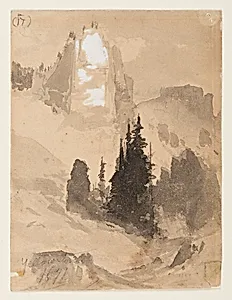
Yellowstone
Classification
landscapes
Department
Smithsonian Collection
Museum
Smithsonian American Art Museum
Credit
Gift of Thomas Moran
Accession Number
1917-17-17
Rights
Public Domain
About this artwork
Research in Progress
Art Historical Context
Thomas Moran's *Yellowstone* (1871) captures the raw majesty of America's first national park in the making. Born in Britain and later a cornerstone of the American art scene, Moran (1837–1926) was a master of luminous landscapes, aligning with the Hudson River School romantic celebration of nature's grandeur. This oil painting, donated by the artist himself to what is now the Smithsonian American Museum, reflects his firsthand exploration of the Yellowstone region during Ferdinand Hayden's 1871 Survey. Moran's vivid depictions played a pivotal role in American history. His sketches and paintings from the expedition, including works like this, were exhibited in Congress, swaying lawmakers to establish Yellowstone National Park in 1872—the world's first. Through dramatic skies, geothermal wonders, and sweeping vistas, Moran not only documented uncharted wilderness but also fueled the conservation movement, blending scientific observation with artistic awe. Though the exact medium awaits further research, *Yellowstone* exemplifies Moran's technique of layering light and color to evoke sublime emotion, inviting viewers to ponder humanity's place in vast, untamed beauty. A true American treasure from the Smithsonian Collection.