
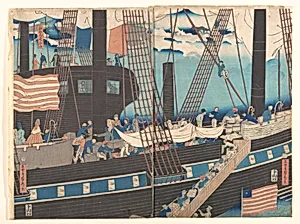
「横浜交易西洋人荷物運送之圖」|“Yokohama Trade: Westerners Loading Cargo”
4th month, 1861
Medium
Pentaptych of woodblock prints; ink and color on paper
Dimensions
Image (a): 14 1/2 x 9 1/2 in. (36.8 x 24.1 cm) Image (b): 14 1/2 x 9 7/8 in. (36.8 x 25.1 cm) Image (c): 14 1/2 x 9 3/4 in. (36.8 x 24.8 cm) Image (d): 14 1/2 x 9 7/8 in. (36.8 x 25.1 cm) Image (e): 14 1/2 x 9 7/8 in. (36.8 x 25.1 cm)
Classification
Prints
Culture & Period
Japan · Edo period (1615–1868)
Department
Asian Art
Museum
Metropolitan Museum of Art, New York, NY
Credit
Bequest of William S. Lieberman, 2005
Accession Number
2007.49.127a–e
Rights
Public Domain
Tags
Art Historical Context
This striking pentaptych by Utagawa Sadahide captures a bustling scene of international commerce in Yokohama harbor. Created in the fourth month of 1861, the five connected woodblock prints show Western traders and laborers loading cargo onto ships, their colorful flags fluttering against a backdrop of masts and crates. The artist, a master of ukiyo-e, uses vibrant inks and meticulous detail to portray both the foreigners’ distinctive clothing and the Japanese workers assisting them. The timing is significant: just seven years after Commodore Perry’s arrival forced Japan to end its long isolation, Yokohama had become one of the newly opened treaty ports. Sadahide’s print belongs to the Yokohama-e genre, which documented the sudden presence of Westerners and the rapid modernization of daily life. Through this lively composition, viewers glimpse Japan’s first tentative steps into global trade during the final years of the Edo period. As a woodblock pentaptych, the work demonstrates the technical sophistication of late-Edo printmaking, allowing an expansive panoramic view while remaining affordable to a broad audience. Today it offers a vivid record of cultural encounter and economic transformation at a pivotal moment in Japanese history.
About the Artist
Utagawa (Gountei) Sadahide · 1807–1873
Utagawa Sadahide was born Hashimoto Kenjirō in 1807 in Fusa Province, in the area of modern Chiba Prefecture, Japan. In the 1820s he entered the studio of the enormously prolific and influential master Utagawa Kunisada, becoming one of Kunisada's most prominent pupils and adopting the studio name Sadahide along with the Utagawa school's celebrated lineage. By 1828 his name appeared on a monument l...