
Yomut Main Carpet
Unknown Artist
first half 19th century
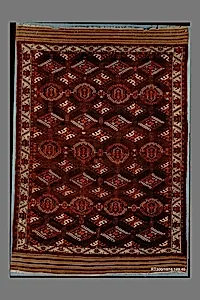
Medium
Wool (warp, weft); asymmetrically knotted pile
Dimensions
H. 110 in. (279.4 cm) W. 78 1/2 in. (199.4 cm)
Classification
Textiles-Rugs
Department
Islamic Art
Museum
Metropolitan Museum of Art, New York, NY
Credit
Bequest of Joseph V. McMullan, 1973
Accession Number
1974.149.45
Rights
Public Domain
Art Historical Context
The *Yomut Main Carpet woven in the first half of the19th century, hails from the Yom Turkmen, a nomadic Turkic tribe Central Asia whose intricate textiles were essential to daily life and cultural identity. As a prime example of Islamic art, this large rug—measuring over 9 feet high and 6.5 feet wide—likely served as a central floor covering in a tribal tent, symbolizing status and craftsmanship. Acquired through the generous bequest of Joseph V. McMullan in 1973, it now graces the Metropolitan Museum of Art's collection of textiles. Crafted from wool for both warp and weft, the carpet features an asymmetrically knotted pile, a technique characteristic of Turkmen weaving that allows for dense, patterns and vibrant dyes derived from natural sources. This method, often called the "Turkish knot," enabled weavers—typically women—to create bold geometric motifs that conveyed tribal affiliations and protective symbolism, blending utility with artistry. Its historical significance lies in preserving the nomadic traditions of the Yomut people amid 19th-century upheavals in the region, offering visitors a tactile window into the artistry of pre-industrial Central Asia. A testament to enduring skill, this rug invites contemplation of how textiles wove stories across vast steppes.