
Yomut Main Carpet
Unknown Artist
probably late 18th century
Medium
Wool pile on wool and cotton foundation
Dimensions
H. 108 1/2 in. (275.6 cm) W. 69 in. (175.2 cm)
Classification
Textiles-Rugs
Department
Islamic Art
Museum
Metropolitan Museum of Art, New York, NY
Credit
Bequest of Joseph V. McMullan, 1973
Accession Number
1974.149.44
Rights
Public Domain
Art Historical Context
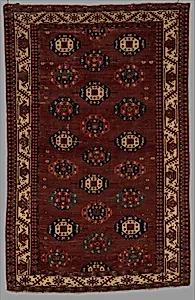
This magnificent *Yomut Main Carpet likely woven in the late 18th century, hails from the Yomut Turkmen, a nomadic tribe of Central Asia whose intricate rugs were essential for life in portable tents. Measuring an impressive 108½ by 69 inches, this large-scale piece would have served as the central floor covering in a yurt, providing warmth, status, and cultural identity. As part of the Metropolitan Museum of Art's Islamic collection—gifted through the bequest of collector Joseph V. McMullan in 1973—it exemplifies the enduring legacy of Turkmen weaving traditions. Crafted in wool pile on a wool and cotton foundation, the carpet showcases the labor-intensive techniques of nomadic artisans: hand-knotted pile for durability and texture, with symmetrical knotting typical of Turkoman rugs. These carpets often feature bold geometric motifs, tribal "guls" (emblematic patterns), and vibrant dyes from natural sources, reflecting both aesthetic beauty and protective symbolism in a pastoral, Islam-influenced world. Though the artist remains unknown, such works highlight the anonymous mastery of generations of weavers, bridging utility and art in pre-modern Central Asia.