
Yosemite
Classification
ceramics
Department
Smithsonian Collection
Museum
Smithsonian American Art Museum
Credit
Gift of the Brooklyn Museum of Art, Paul F. Walter Collection
Accession Number
1999-42-14
Rights
Public Domain
About this artwork
Research in Progress
Art Historical Context
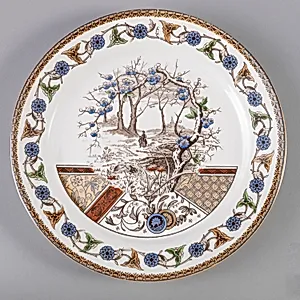
"Yosemite," created in 1883 by the esteemed British ceramics firm Thomas and Richard Boote—established in 1842—captures the majestic allure of America's iconic natural wonder. This ceramic piece, now housed in the Smithsonian American Museum as part of the Smithsonian Collectiongift of the Brooklyn Museum of Art, Paul F. Collection), reflects the Victorian era's fascination with grand landscapes. The Bootes, renowned Staffordshire potters, often produced decorative wares that bridged British craftsmanship with global inspirations, making scenes like Yosemite accessible to middle-class homes on both sides of the Atlantic. Though the specific medium remains under research, the work exemplifies 19th-century ceramics' role in democratizing art. Transfer-printed earthenware or similar techniques were hallmarks of the period, allowing intricate designs of rugged valleys and towering cliffs to adorn everyday objects like vases or plates. Produced just seven years before Yosemite's designation as a national park in 1890, it echoes the Romantic movement's reverence for untamed nature, popularized by American painters like Albert Bierstadt. As a highlight in the museum's ceramics classification, "Yosemite" underscores cultural exchange between Britain and the U.S., inviting visitors to ponder how pottery preserved wanderlust in an age of exploration. Ongoing research promises deeper insights into its techniques and story.