
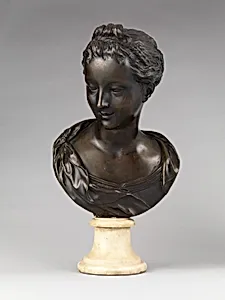
Young Girl
ca. 1720
Medium
Bronze, olive-brown patina
Dimensions
Overall (confirmed): 15 x 10 1/4 x 8 5/16 in.; 25lb. (38.1 x 26 x 21.1 cm; 11.3399kg); Height on socle: 19 3/16 in. (48.7 cm)
Classification
Sculpture-Bronze
Culture
French, Paris
Department
European Sculpture and Decorative Arts
Museum
Metropolitan Museum of Art, New York, NY
Credit
Bequest of Mary Strong Shattuck, 1935
Accession Number
35.80.53
Rights
Public Domain
Tags
Art Historical Context
Nestled in the European Sculpture and Decorative Arts at the Metropolitan Museum of Art, *Young Girl* by French sculptor Robert Le Lorrain (1666–1743) the delicate charm of early 18th portraiture. Created around 1720 in Paris during the period following Louis XIV's reign, this bronze sculpture with its rich olive-brown patina stands at 15 inches tall on its socle, weighing a substantial 25 pounds. Le Lorrain, a master of the Académie Royale and renowned for his fountains and architectural decorations, here turns his skill to a intimate bust of a young girl, blending realism with graceful elegance. The work exemplifies the transition from Baroque grandeur to the lighter, more playful Rococo style emerging in France. The bronze medium, prized for its durability and ability to hold fine details, allowed Le Lorrain to render the girl's features with lifelike tenderness—soft cheeks, flowing hair, and a poised expression that hints at aristocratic youth. The olive-brown patina, achieved through chemical processes, enhances its warm, aged allure, making it a coveted cabinet piece for 18th-century collectors. Bequeathed to the Met in 1935 by Mary Strong Shattuck, *Young Girl* invites visitors to ponder the lives of long-ago children amid Paris's vibrant artistic scene. Its modest scale belies its cultural weight, offering a window into the era's fascination with personal portraiture and refined decorative arts.