
Young Girl Drawing
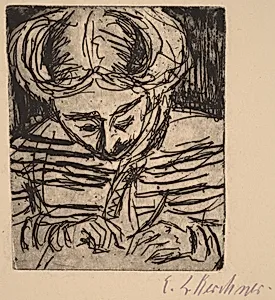
Medium
etching
Dimensions
image: 9.4 x 7.8 cm (3 11/16 x 3 1/16 in.) sheet: 27.5 x 20 cm (10 13/16 x 7 7/8 in.)
Classification
Department
CG-W
Museum
National Gallery of Art, Washington, D.C.
Credit
Gift of Ruth Cole Kainen
Accession Number
2012.92.707
Rights
Public Domain
Art Historical Context
Ernst Ludwig Kirchner's *Young Girl Drawing* (1906) is a delicate etching that captures a quiet moment of youthful concentration. Created just a year after Kirchner co-founded Die Brücke, the German Expressionist group in Dresden, this small print (image measures 9.4 x 7.8 cm) exemplifies the movement's raw emotional intensity and rejection of academic traditions. The artist, a pioneering figure in early 20th-century modernism, used sharp, energetic lines to convey the girl's absorbed focus, blending tenderness with the bold distortion characteristic of Expressionism. As an etching—a printmaking technique where acid bites into a metal plate to create rich, textured lines—Kirchner's work highlights the medium's potential for intimacy and immediacy. Prints like this were affordable and reproducible, allowing avant-garde artists to reach wider audiences amid Europe's cultural upheavals. The modest sheet size (27.5 x 20 cm) suggests it was designed for personal collections, evoking the group's bohemian ethos of direct, unpolished expression. Housed in the National Gallery of Art's Department of Modern Prints (gift of Ruth Cole Kainen), this piece offers a glimpse into Kirchner's early experimentation, bridging his academic training with the revolutionary spirit that would influence global art. Visitors will appreciate its subtle power: a simple scene that pulses with creative vitality.
About the Artist
Ernst Ludwig Kirchner · 1880–1938
Ernst Ludwig Kirchner was born on May 6, 1880, in Aschaffenburg, Germany, to parents Ernst and Maria Kirchner, part of a family of Prussian descent that frequently relocated due to his father's career as a chemical technician. After early schooling in various towns, he studied architecture at the Königliche Technische Hochschule (Technical University) in Dresden from 1901 to 1905, taking courses i...