
Young Maoris
1896/97
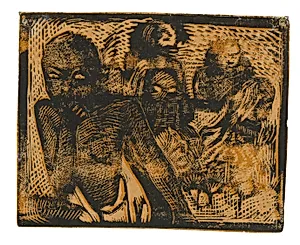
Medium
Wood-block print printed twice in yellow ocher and black ink, on cream wove notebook paper ruled in blue
Dimensions
Image/sheet: 8.8 × 10.7 cm (3 1/2 × 4 1/4 in.)
Classification
woodcut
Department
Prints and Drawings
Museum
Art Institute of Chicago
Accession Number
76710
Rights
Public Domain
Art Historical Context
**Young Maoris** is a captivating woodcut print by Paul Gauguin created around 1896–97 during his second stay in Tahiti. Gauguin, a leading Post-Impressionist, escape from modern Europe in the South Seas, where he immersed himself in Polynesian culture. This intimate work depicts young Maoris—likely inspired by the indigenous peoples he encountered—capturing his idealized vision of a "primitive" paradise. Measuring just 8.8 × 10.7 cm, it feels personal, almost like a sketch from his notebook. Printed twice in yellow ocher and black ink on cream wove notebook paper ruled in blue, the piece showcases Gauguin's experimental printmaking. He carved the woodblock himself, layering colors for depth and texture, a technique that echoes Japanese ukiyo-e influences while asserting his bold, flattened forms and symbolic style. The ruled paper adds a raw, improvisational charm, hinting at works made in resource-scarce conditions. Housed in the Art Institute of Chicago's Prints and Drawings department, **Young Maoris** highlights Gauguin's fusion of Western innovation with exotic subjects, influencing modern art's embrace of non-Western aesthetics. It's a window into his quest for authenticity amid cultural romanticism—a small gem revealing the artist's restless creativity.
About the Artist
Paul Gauguin · 1848–1903
Paul Gauguin (1848-1903) was a French Post-Impressionist painter whose bold experiments with color, form, and subject matter made him one of the most influential figures in the transition from 19th-century art to modernism. His rejection of European civilization for the perceived authenticity of 'primitive' cultures established an archetype of artistic exile that continues to resonate. Gauguin's ...