
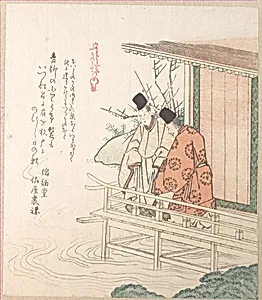
Young Nobleman and His Attendant
19th century
Medium
Woodblock print (surimono); ink and color on paper
Dimensions
8 3/8 x 7 1/4 in. (21.3 x 18.4 cm)
Classification
Prints
Culture & Period
Japan · Edo period (1615–1868)
Department
Asian Art
Museum
Metropolitan Museum of Art, New York, NY
Credit
H. O. Havemeyer Collection, Bequest of Mrs. H. O. Havemeyer, 1929
Accession Number
JP2000
Rights
Public Domain
Tags
Art Historical Context
In the elegant world of Edo-period Japan (1615–1868), Kubo Shunman’s *Young Nobleman and His Att* (19th century) captures a moment of refined urban life through the intimate format of a surimono woodblock print Measuring just 8 3/8 x 7 1/4 inches, this ink and color on paper work depicts a youthful nobleman accompanied by his attendant amid architectural elements like houses, evoking the bustling streets of Edo (modern Tokyo). Shunman, a versatile ukiyo-e artist and poet, excelled in these privately commissioned prints, blending delicate lines with vibrant hues to portray everyday elegance. Surimono were luxurious, limited-edition prints often produced for New Year’s greetings or poetry gatherings among the elite, featuring advanced techniques like subtle embossing, metallic pigments, and precise color registration. Unlike mass-produced ukiyo-e, their small scale and high craftsmanship made them treasured keepsakes, showcasing Japan’s mastery of woodblock printing during a golden age of visual culture. Part of the Metropolitan Museum of Art’s H. O. Havemeyer Collection (bequeathed in 1929), this piece highlights the global appreciation for Japanese art in the West. It invites us to ponder the social hierarchies and aesthetic harmony of samurai-era society, where even a fleeting scene carried poetic depth.
About the Artist
Kubo Shunman · 1757–1820
Japanese, 1757–1820