
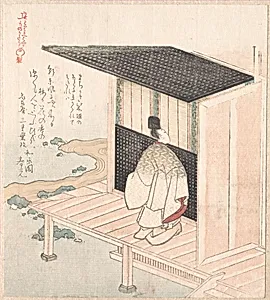
Young Nobleman Looking Inside of a House
19th century
Medium
Woodblock print (surimono); ink and color on paper
Dimensions
8 x 7 1/8 in. (20.3 x 18.1 cm)
Classification
Prints
Culture & Period
Japan · Edo period (1615–1868)
Department
Asian Art
Museum
Metropolitan Museum of Art, New York, NY
Credit
H. O. Havemeyer Collection, Bequest of Mrs. H. O. Havemeyer, 1929
Accession Number
JP1992
Rights
Public Domain
Tags
Art Historical Context
In the intimate world of Edo-period Japan (1615–1868), Kubo Shunman's *Young Nobleman Looking Inside of a House* captures a fleeting moment of curiosity and voyeurism. Created in the early 19th century, woodblock print (surono) depicts a finely dressed young nobleman peering a latticed window into a private home, evoking the playful, everyday intrigues of urban life in Tokyo (then Edo). Shunman, a master poet and ukiyo-e artist (1777–1845), specialized in these luxurious, privately commissioned prints, often produced for New Year's greetings or poetry circles. Surimono like this one stand out for their exquisite craftsmanship: small in scale (8 x 7 1/8 in.), they feature vibrant inks, subtle colors, and advanced techniques such as embossing and mica dusting for a shimmering effect. Unlike mass-produced ukiyo-e, surimono were elite connoisseur's items, blending visual artistry with inscribed kyōka poems—humorous twists on classical waka. This piece reflects the period's fascination with *mitate* (parody) and the blurred lines between public and private spaces in bustling merchant culture. Housed in the Metropolitan Museum of Art's Asian Art Department from the H.O. Havemeyer Collection, it invites visitors to ponder the nobleman's secretive gaze—perhaps a metaphor for desire or social transgression in a rigidly hierarchical society. A gem of Japanese printmaking's golden age!
About the Artist
Kubo Shunman · 1757–1820
Japanese, 1757–1820