
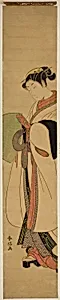
Young Woman Dressed as a Mendicant Monk
c. 1770
Medium
Color woodblock print; hashira-e
Dimensions
68.3 × 12.7 cm (26 7/8 × 5 in.)
Classification
woodblock print
Department
Arts of Asia
Museum
Art Institute of Chicago
Accession Number
22970
Rights
Public Domain
Art Historical Context
Suzuki Harunobu's *Young Woman Dressed as Mendicant Monk* (c. 1770) is a captivating example of ukiyo-e, the "pictures of the floating world" genre that flourished in Edo-period Japan (1603–1868). This color woodblock print depicts a youthful woman playfully disguised as a wandering mendicant monk, themes of beauty, disguise, and everyday life. Harunobu, a pioneering artist, revolutionized printmaking by introducing full-color nishiki-e techniques around 1765, allowing for vibrant hues and subtle gradations that brought his subjects to life with unprecedented realism and elegance. The artwork's hashira-e format—tall and narrow at 68.3 × 12.7 cm—sets it apart, designed to hang from wooden pillars in homes or teahouses, offering an intimate vertical view. This slender composition highlights the figure's graceful pose and detailed robes, showcasing Harunobu's mastery of line, color layering, and delicate patterns. Such prints were affordable luxuries for urban merchants and samurai, democratizing art during Japan's vibrant merchant culture. Culturally, the image reflects the era's fascination with gender fluidity and kabuki theater cross-dressing (onnagata), infusing whimsy into spiritual motifs. Housed in the Art Institute of Chicago's Arts of Asia collection, it invites visitors to ponder the playful intersections of identity and artistry in 18th-century Japan.
About the Artist
Suzuki Harunobu · 1725–1770
Suzuki Harunobu (c. 1725-1770) was a Japanese ukiyo-e artist who revolutionized woodblock printing by developing nishiki-e—full-color prints using multiple woodblocks—in 1765. Before Harunobu, Japanese prints were limited to two or three colors; his innovation unleashed the entire artist's palette, transforming ukiyo-e into the vibrant art form that would later captivate Western artists from Manet...