
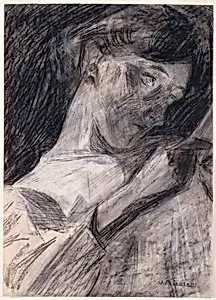
Young Woman Reading (Ines)
1909–10
Medium
Charcoal, watercolor, and wax crayon on paper
Dimensions
18 3/8 x 13 1/8 in. (46.7 x 33.3 cm)
Classification
Drawings
Department
Modern and Contemporary Art
Museum
Metropolitan Museum of Art, New York, NY
Credit
Bequest of Lydia Winston Malbin, 1989
Accession Number
1990.38.11
Rights
Public Domain
Tags
Art Historical Context
Umberto Boccioni’s *Young Woman Reading (Ines)* offers an intimate glimpse into a quiet moment of contemplation. Created between 1909 and 1910, the portrays a young woman absorbed in her book, her downward gaze and relaxed posture conveying a sense of everyday calm. The work belongs to the Metropolitan Museum of Art’s modern collection, where it highlights Boccioni’s early interest in human subjects before his later embrace of more dynamic themes. The artist employs a distinctive mix of charcoal, watercolor, and wax crayon on paper. Charcoal provides soft, velvety shading that models the figure’s face and clothing, while delicate watercolor washes add subtle color. Wax crayon introduces delicate highlights and texture, giving the surface a lively, layered quality that rewards close viewing. This combination of dry and wet media was well suited to capturing both precise details and atmospheric effects in a modest-sized sheet measuring roughly 18 by 13 inches. As a portrait tagged simply with “women” and “reading,” the drawing celebrates a timeless subject—the private pleasure of books—while demonstrating Boccioni’s skillful draftsmanship. Its gentle mood and refined technique make it an engaging example of early twentieth-century works on paper.
About the Artist
Umberto Boccioni · 1882–1916
Umberto Boccioni (1882–1916) was an Italian painter and sculptor who became the leading artist and principal theorist of the Futurist movement. Born in Reggio Calabria, he studied in Rome under the Divisionist painter Giacomo Balla and was deeply influenced by Post-Impressionism before encountering the ideas of Filippo Tommaso Marinetti, whose 1909 Futurist Manifesto catalyzed Boccioni's artistic ...