
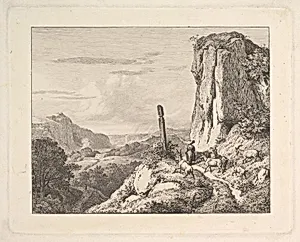
Young Woman with Six Goats
Medium
Etching; third state
Dimensions
plate: 6 1/8 x 7 5/8 in. sheet: 9 3/8 x 12 1/2 in.
Classification
Prints
Department
Drawings and Prints
Museum
Metropolitan Museum of Art, New York, NY
Credit
Gift of J. B. Neumann, 1960
Accession Number
60.681.42
Rights
Public Domain
Tags
Art Historical Context
In the serene etching *Young Woman with Six Go*, created by German printmaker Johann Christoph Er in 1815, we encounter a charming pastoral vignette. A young woman tends to her lively herd amid a lush landscape, capturing the quiet harmony of rural life. Rendered in the third state of this etching—a refined impression after the artist reworked the plate—the image measures a modest plate size of 6 1/8 x 7 5/8 inches, inviting intimate contemplation. Now housed in the Metropolitan Museum of Art's Drawings and Prints department, it was generously gifted by J.B. Neumann in 1960. Erhard (1795–1842), based in Nuremberg, was a master etcher influenced by 17th-century Dutch masters like Rembrandt, blending meticulous line work with Romantic sensitivity to nature. Etching allowed him to achieve delicate textures—the soft fur of the goats, the woman's flowing garments, and the rolling hills—through acid-bitten lines on a metal plate, a technique prized for its spontaneity and precision during the early 19th century. This work reflects post-Napoleonic Europe's nostalgia for simple, idyllic scenes amid social upheaval, highlighting Erhard's skill in genre and landscape prints. A delightful glimpse into everyday wonder, it reminds us how art can distill the poetry of the commonplace.
About the Artist
Johann Christoph Erhard · 1795–1822
Johann Christoph Erhard (1795–1822) was a German painter and etcher of the Romantic era whose sensitive landscape studies and skillful prints earned him a growing reputation before his tragically early death at twenty-six. Born in Nuremberg, he studied at the Nuremberg Academy and later in Munich, where he was influenced by the Romantic landscape tradition and the revival of interest in the art of...